Case Study: WhatsApp Automation for Pet Stores & Veterinary Clinics
How Invoice Intelligence Turns Pet Purchases Into Predictable Engagement, Refill, and Care Journeys
Industry Background & Core Problem in Pet
The Business Context
Pet stores and veterinary clinics operate in predictable care cycles, yet most rely on manual reminders and generic broadcasts. This case study explains how WhatsApp Automation for Pet Stores, powered by Waliner.io, transforms invoice data into predictive engagement journeys that improve refills, booster compliance, and repeat visits.
By early 2024, the clinic was processing over 3,000 invoices per month. Footfall was stable. Product range had expanded. Marketing efforts were consistent. On the surface, the business appeared healthy.
Yet revenue growth had slowed. Repeat visits were inconsistent. Booster vaccinations were frequently missed. Premium food buyers were not reliably returning within expected refill windows. Chronic medication adherence was unmonitored. Unpaid service invoices required manual follow-up calls from staff.
The management team initially attributed this to competitive pressure and pricing sensitivity. However, a deeper operational review revealed a more structural issue.
The business was operating transactionally in a lifecycle-driven industry.
The Nature of the Pet Care Lifecycle
Pet care is inherently cyclical. A purchase is rarely a one-time event.
A 10kg dog food bag typically lasts 28–35 days depending on breed size.
Deworming schedules repeat every 3 months.
Vaccination boosters follow defined medical intervals.
Grooming services often recur monthly.
Chronic medication for aging pets requires structured refills.
These cycles are predictable. And critically, every one of these signals is recorded inside invoices.
Each invoice at HappyPaws included:
• Customer name and phone number
• Date of purchase
• SKU-level item details
• Quantity and pack size
• Treatment or vaccine category
• Payment status
• Invoice total
In theory, this data could power replenishment reminders, vaccine scheduling, adherence modeling, and payment automation.
In practice, invoices were stored as PDFs inside the POS system and accounting software. They were never extracted into structured intelligence.
Operational Friction Emerges
Because invoice data was not activated, operational challenges accumulated.
First, food replenishment was unpredictable. Customers only returned when they remembered—or when the food had already run out. There was no system calculating expected consumption based on quantity and historical behavior.
Second, vaccine booster compliance depended on manual diary entries. As volumes increased, reminders were missed. Compliance rates fell below internal targets.
Third, chronic medication patterns were invisible. Some pets required monthly refills. Others purchased episodically. Without SKU-level tracking and behavior modeling, no segmentation was possible.
Fourth, unpaid invoices required staff to manually call customers. This consumed administrative time and created avoidable friction.
Fifth, there was no RFM (Recency, Frequency, Monetary) segmentation. High-value long-term pet parents were not distinguished from one-time visitors.
The business had data. But it did not have intelligence.
Invoices were treated as financial records rather than behavioral triggers.
The Core Realization
The management team reached a pivotal insight:
The problem was not marketing.
The problem was the absence of transaction-driven automation.
Pet care requires continuity.
Continuity requires structured data.
Structured data must originate from invoices.
Without extracting invoice intelligence and linking it to contextual WhatsApp engagement, growth would remain dependent on generic promotions rather than predictable lifecycle automation.
This realization set the foundation for implementing invoice-driven WhatsApp automation, not as a marketing experiment, but as an operational transformation.
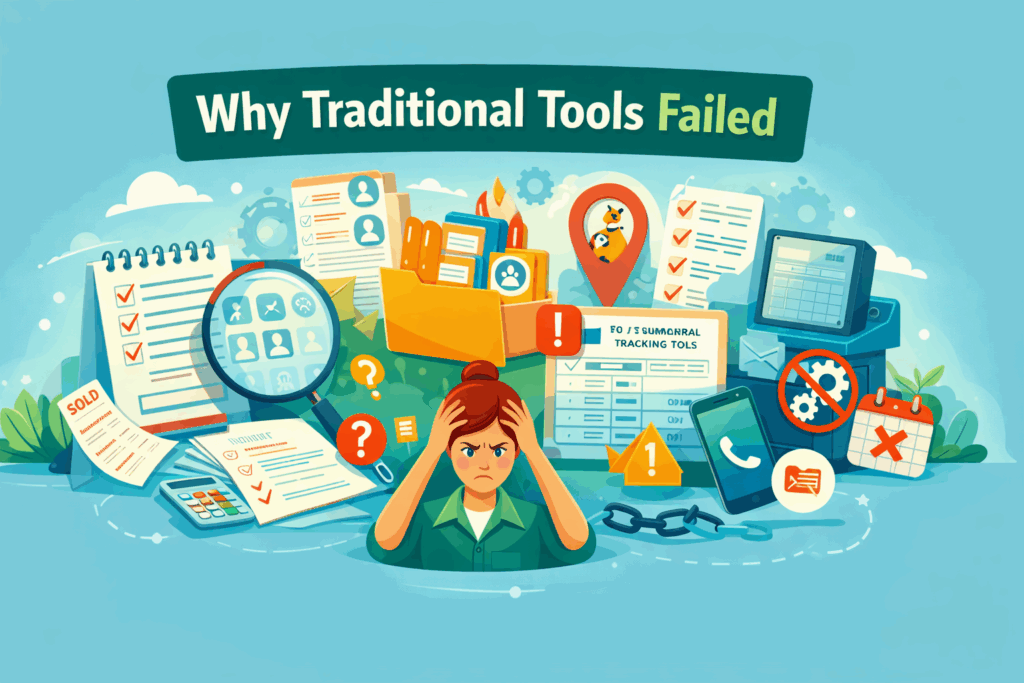
Why Traditional Tools Failed Pet Stores & Vet Clinics
The Initial Assumption: “We Already Have a System”
When HappyPaws began examining its operational gaps, the first internal reaction was defensive. The business already had:
• A POS system
• Accounting software
• Customer phone numbers
• WhatsApp access
• Excel sheets for reminders
• Staff managing follow-ups
From a surface perspective, nothing seemed “missing.”
But over several weeks of operational observation, it became clear that the issue was not the absence of tools — it was the absence of intelligence between tools.
The systems stored information. They did not activate it.
POS Systems Store Data, They Do not Interpret It
The clinic’s POS captured every invoice. Each SKU was logged. Each transaction timestamped. Payment status was recorded.
However, the POS performed no behavioral analysis.
It did not calculate:
• When a 12kg premium dog food bag would finish
• Whether a vaccination required a 21-day booster
• If a pet’s arthritis medication indicated chronic care
• Which customers were returning within expected intervals
To the POS, a bag of food was just a line item.
To the business, it represented a future purchase opportunity.
That gap — between record-keeping and prediction — created revenue leakage.
Spreadsheets Could Not Scale
To compensate, front-desk staff-maintained Excel sheets for vaccine reminders and grooming cycles.
Initially, this worked when monthly customer volume was manageable. But as invoice counts crossed 3,000 per month, manual entry became unreliable.
Errors emerged:
• Missed vaccine booster dates
• Duplicate entries
• Outdated phone numbers
• Forgotten chronic patients
• No visibility into who had lapsed
The spreadsheet required constant manual updating. If one employee forgot to log an entry, the system failed.
Automation did not exist. Everything depended on discipline and memory.
WhatsApp Broadcasts Created Noise
The clinic also experimented with promotional broadcasts.
Weekend discounts. Food bundle offers. Grooming promotions.
Engagement rates were inconsistent. Some customers complained about irrelevant messages. Others ignored them entirely.
The core issue was contextual mismatch.
A customer who bought premium food three days ago received a “Buy dog food now” promotion.
A vaccination-only customer received grooming offers.
A lapsed customer received the same message as a frequent visitor.
There was no segmentation based on recency, frequency, or purchase behavior.
Broadcast marketing was replacing lifecycle intelligence.
CRMs Required Manual Tagging
The team evaluated basic CRM platforms. These tools required staff to manually tag customers:
• Dog owner
• Cat owner
• Grooming client
• Vaccine patient
This approach was static and error-prone.
It did not:
• Update automatically after new invoices
• Detect category affinity
• Calculate replenishment cycles
• Track behavioral responsiveness
• Monitor unpaid invoice transitions
CRMs organized contacts. They did not interpret transactional data in real time.
Payment Recovery Was Reactive
Unpaid invoices created another operational strain.
When services were rendered and payment remained pending, staff would manually message or call customers. Sometimes reminders were delayed. Sometimes forgotten.
There was no automated workflow tied to invoice status change.
This resulted in:
• Delayed cash flow
• Administrative overhead
• Awkward human follow-ups
• Inconsistent escalation timing
The system knew when payment was unpaid. But nothing was triggered automatically.
No Unified Customer View
Perhaps the most significant limitation was fragmentation.
Customer data lived in silos:
POS for transactions.
Excel for reminders.
WhatsApp chats for conversations.
Accounting for payments.
There was no unified profile showing:
• Total spend
• Visit frequency
• Category preference
• Predicted next need
• Responsiveness to messages
Without this unified view, strategic decisions were impossible.
The business could not answer basic questions like:
Who are our top 20% highest lifetime value pet parents?
Which chronic patients are at risk of lapse?
Which customers respond best to reminders?
What percentage of booster vaccines are completed on time?
The Structural Failure
The deeper failure was architectural.
Traditional tools treated transactions as completed events.
Pet care, however, is built on future needs.
Invoices should not mark the end of engagement.
They should mark the beginning of the next lifecycle trigger.
HappyPaws realized that without:
• Invoice extraction
• Line-item intelligence
• Behavioral prediction
• Automated WhatsApp orchestration
• Consent and frequency governance
• Real-time analytics
They would remain dependent on manual effort and generic messaging.
The conclusion was clear:
The business did not need more marketing.
It needed invoice-driven automation.
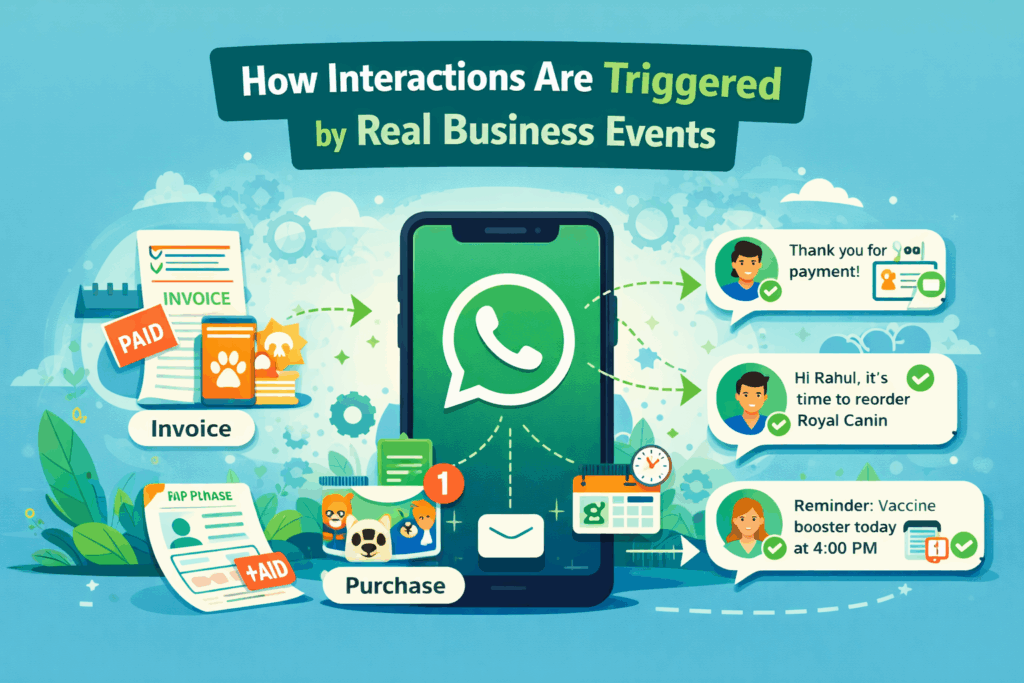
How Invoice Data Triggers Real Business Interactions
The Shift from Campaign Thinking to Event Thinking
After identifying the limitations of traditional tools, HappyPaws faced a critical strategic decision.
Should they continue building better promotional campaigns?
Or should they redesign engagement around real operational events?
They chose the second path.
Pet care is not driven by calendar-based campaigns. It is driven by biological, medical, and consumption events.
A food bag empties.
A vaccine reaches its booster window.
A chronic medication runs low.
A grooming interval approaches.
An invoice remains unpaid.
Each of these is not a marketing opportunity. It is a natural trigger point in the pet’s lifecycle.
The insight was simple but powerful:
Every meaningful engagement should begin when something real happens in the business.
And the only consistent, reliable source of those “real moments” was the invoice.
Identifying the Core Trigger Events
Once invoice extraction was introduced, HappyPaws began mapping specific operational events that should trigger engagement automatically.
The primary trigger categories were defined as follows:
1. Purchase Completion (Invoice Created – Paid)
When a pet owner completes a purchase or treatment, that invoice marks the start of a future need.
This event should immediately trigger:
• A thank-you message with invoice details
• A predictive replenishment calculation
• A lifecycle timer based on category
2. Food Purchase Event
The system detects:
• Brand
• Pack size
• Quantity
• Historical purchase interval
From this, it estimates the expected depletion date.
Instead of guessing a 30-day reminder, the system calculates a probable window — for example, 28–34 days — based on prior behavior.
That estimated depletion date becomes the next trigger.
3. Vaccination Event
When a vaccine SKU is identified in the invoice, the system maps it to its known booster schedule.
For example:
• 21-day booster
• 6-month follow-up
• Annual renewal
This converts a completed treatment into a scheduled future event automatically — without manual diary entry.
4. Chronic Medication Event
If the system detects recurring medication SKUs across multiple invoices, it flags the pet as a chronic-care profile.
The interval between purchases becomes the predictive model for refill timing.
If the pet typically refills every 30 days but has not returned by Day 32, that absence becomes a trigger.
5. Unpaid Invoice Status Change
If an invoice is marked unpaid or partially paid, the system schedules structured reminders:
• First reminder after a defined time window
• Escalation reminder if unpaid
• Stop sequence if payment webhook confirms completion
This removes the need for manual follow-up calls.
Why Transactional Triggers Outperform Campaigns
When engagement is triggered by real events:
Timing improves.
Relevance increases.
Customer irritation decreases.
Response rates rise.
For example:
Instead of sending “Dog Food Offer – This Weekend,”
The message becomes:
“Your pet’s 10kg pack is likely finishing soon. Reorder in one tap.”
The second message aligns with the pet owner’s actual need.
Similarly:
Instead of “Visit us for vaccinations,”
The message becomes:
“Your pet’s booster is due in 5 days.”
This shift moves communication from promotional to service-oriented.
Converting Documents into Engagement Signals
The technical breakthrough at this stage was not messaging, it was document intelligence.
Each invoice, once processed through OCR and structured extraction, became a signal generator.
Invoice → Structured Fields → Category Mapping → Event Classification → Trigger Queue
The system no longer treated invoices as completed financial documents.
It treated them as the beginning of future lifecycle flows.
Every new invoice updated the customer profile in real time.
If a customer purchased food earlier than predicted, the refill reminder schedule recalibrated.
If payment status changed, reminder sequences stopped automatically.
If a booster was completed, the next booster timer reset.
Engagement became dynamic rather than fixed.
Operational Confidence Through Event Mapping
Within weeks of implementing event-driven logic, HappyPaws observed something unexpected.
Staff anxiety reduced.
There was no longer a need to remember which pet was due for what.
There was no fear of missing booster reminders.
There was no confusion over unpaid follow-ups.
The system monitored operational events continuously and translated them into structured WhatsApp journeys.
Instead of relying on marketing calendars, the clinic began relying on transactional truth.
This marked the transition from reactive communication to predictive engagement.
Data Capture Without New Tools
The Fear of “Another System”
When HappyPaws first explored automation, the leadership team had a practical concern.
They did not want another complicated software implementation.
They did not want:
• API integration projects
• POS replacement
• Developer dependency
• Staff retraining
• Disruption to billing workflows
Like most growing pet businesses, their operational bandwidth was limited. Any solution that required changing billing software or retraining reception staff would likely fail.
The solution had to work within existing behavior.
This is where the zero-integration model became critical.
Using Existing Workflows as the Foundation
Instead of changing how invoices were generated, Waliner worked with what already existed.
HappyPaws continued using their existing POS.
Invoices continued being generated the same way.
Staff behavior remained unchanged.
The only difference was what happened after the invoice was created.
Invoices were now sent to the system via two simple methods:
- WhatsApp upload template
- Drag-and-drop upload in a web portal
No API configuration.
No software replacement.
No technical onboarding complexity.
Staff simply forwarded invoices they were already generating.
From the team’s perspective, nothing operational changed.
From the system’s perspective, everything changed.
Turning Static PDFs into Structured Intelligence
Once uploaded, invoices moved through a structured pipeline:
• File normalization
• OCR processing
• Table detection
• Key-value extraction
• SKU-level parsing
• Date and currency normalization
• Phone number formatting
• Duplicate customer merging
This process transformed unstructured PDFs into machine-readable data fields.
For example, a food invoice was converted into:
Customer: Rahul Mehta
Phone: +91XXXXXXXXXX
Item: Royal Canin Adult 10kg
Category: Dog Food
Quantity: 1
Invoice Date: 12 Jan
Payment Status: Paid
Total: ₹5,200
Previously, this data was locked inside a PDF.
Now, it became actionable intelligence.
Eliminating Manual List Creation
Before automation, front-desk staff had to manually prepare reminder lists.
They would search through records to identify:
• Pets vaccinated last month
• Food buyers nearing refill
• Customers with unpaid bills
This process was time-consuming and often inaccurate.
After invoice extraction was implemented, segmentation happened automatically.
The system continuously updated:
• New vs returning customers
• High-frequency food buyers
• Chronic medication profiles
• Booster-due patients
• Lapsed customers
• Payment-pending invoices
There was no manual tagging.
No static list building.
No campaign preparation delay.
The system updated profiles every time a new invoice was ingested.
Minimal Training, Maximum Impact
One of the reasons the implementation succeeded at HappyPaws was simplicity.
Reception staff were trained in less than one hour.
Their new routine was:
“After billing, upload invoice.”
That was it.
They did not need to understand segmentation logic.
They did not need to manage campaign schedules.
They did not need to interpret analytics dashboards.
Automation ran in the background.
Reducing Operational Friction
Within the first month, measurable operational changes occurred:
• Manual reminder sheets were discontinued.
• Vaccine diary tracking was phased out.
• Payment follow-ups reduced significantly.
• Staff spent less time searching for customer history.
More importantly, engagement became consistent.
Every invoice triggered structured evaluation.
Every evaluation produced a potential future engagement event.
The data pipeline operated continuously — without human dependency.
Why Zero-Integration Was Critical
Waliner does not require POS, ERP, or CRM integrations. It acts as a Revenue Intelligence Layer that sits on top of any legacy billing system by ingesting invoices as the universal data source. Regardless of whether a business uses Tally, Busy, Marg, Zoho, custom ERP, or manual billing software, Waliner extracts structured data from invoices and builds behavioral intelligence without disrupting operations. This eliminates compatibility concerns and allows seamless scaling across multi-location and enterprise setups while preserving existing workflows.
From Unstructured Data to Actionable Intelligence
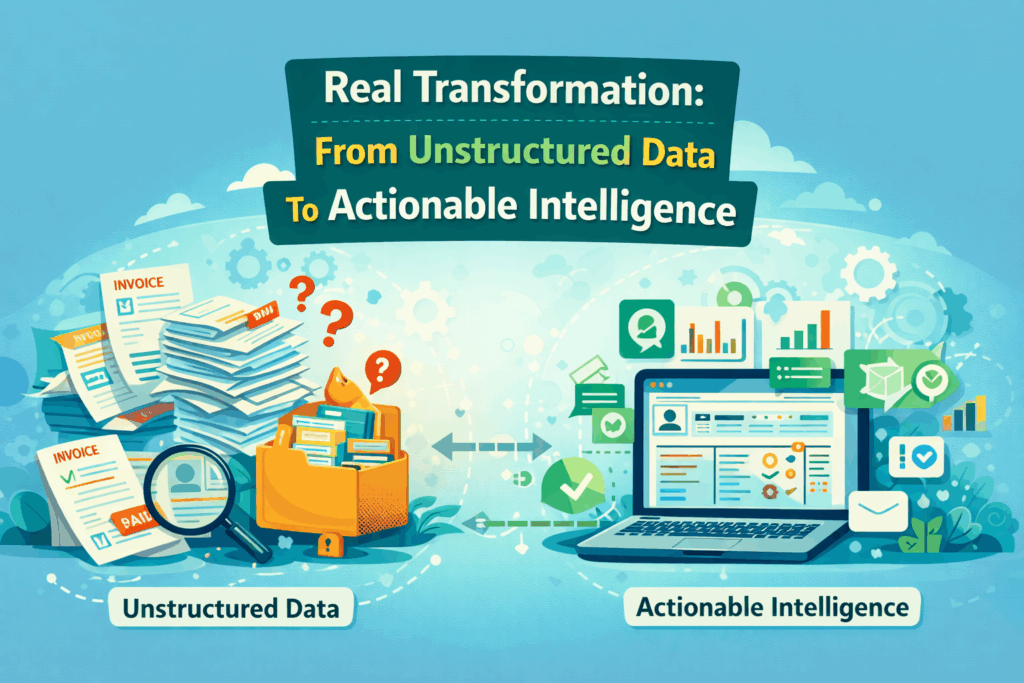
Moving from “Invoice Storage” to “Invoice Intelligence”
Until this point, HappyPaws had data. What they did not have was interpretation.
This is where Waliner became central to the transformation.
Waliner is not just a messaging layer. It is an Invoice Intelligence & WhatsApp Engagement Platform designed specifically to convert transactional documents into structured behavioral intelligence.
The turning point for HappyPaws came when invoices stopped being archived and started being analyzed.
Once uploaded, Waliner’s extraction engine converted each PDF into structured fields:
• Customer identity (name, phone, timezone)
• Invoice ID and timestamp
• Line items with category mapping
• SKU family (food, grooming, vaccine, chronic medication)
• Quantity and pack size
• Payment status
• Total spend
• Historical purchase comparison
This structured layer changed everything.
Previously, a dog food purchase was just a sale.
Now, it became a predictive signal.
How Waliner Structured Pet Behavior
After extraction, Waliner created unified customer profiles.
If a pet owner had 12 invoices across 9 months, those documents were merged into a single behavioral view.
From this view, Waliner calculated:
Recency – When did they last visit?
Frequency – How often do they return?
Monetary Value – What is their average spend?
Category Affinity – Food-only? Grooming-focused? Chronic care?
Replenishment Pattern – How long between food purchases?
This RFM + category modeling allowed segmentation without manual tagging.
Instead of staff labeling someone “Dog Owner,” the system inferred it from SKU history.
Instead of guessing refill cycles, Waliner measured them.
The Replenishment Engine in Action
One of the most powerful transformations came from Waliner’s replenishment logic.
For example:
A customer purchased a 10kg premium dog food bag on January 1st.
The previous interval between purchases was 30 days.
Before that, 32 days.
Waliner calculated an expected refill window around Day 29–33.
On Day 28, the system queued a contextual WhatsApp reminder:
“Hi Rahul, your pet’s Royal Canin 10kg pack may be finishing soon. Would you like to reorder?”
This was not a broadcast.
It was not a guess.
It was behavior-backed timing.
If the customer reordered early, the model recalibrated.
If they ignored the reminder, a second gentle nudge followed within defined frequency caps.
This predictive capability is native to Waliner’s invoice-driven architecture.
From Manual Memory to Predictive Lifecycle Mapping
Before Waliner, staff relied on memory and static lists.
After Waliner, every invoice automatically updated:
• Vaccine booster schedules
• Chronic medication adherence
• Grooming cadence
• Payment recovery tracking
• Customer lifetime value scoring
For vaccination SKUs, Waliner mapped known booster intervals.
For chronic medication, repeated purchase intervals built adherence models.
For unpaid invoices, payment-status triggers initiated structured reminder workflows.
Each update happened in real time — without human intervention.
Intelligence Before Messaging
A key principle in Waliner’s architecture is that messaging happens only after intelligence evaluation.
Before any WhatsApp template is sent, the system checks:
• Consent status
• Frequency caps
• Quiet hours
• Journey priority (utility > recovery > replenishment > promo)
• Customer responsiveness history
This prevents spam behavior and protects WhatsApp quality rating.
HappyPaws noticed that engagement quality improved significantly because messages were expected and relevant.
Dashboard-Level Visibility
Waliner also provided analytics that HappyPaws had never previously accessed:
• Food replenishment adherence rate
• Booster compliance percentage
• Chronic medication refill lag
• Unpaid recovery timeline
• RFM segment distribution
• Customer lifetime value tiers
• Read, click, and conversion metrics
For the first time, management could see not just revenue — but behavioral health of the customer base.
The True Transformation
The real shift was not automation.
It was visibility.
Waliner transformed:
Unstructured PDFs → Structured customer intelligence
Static transaction history → Predictive lifecycle mapping
Manual reminders → Event-triggered WhatsApp journeys
Reactive marketing → Data-backed engagement
At this stage, HappyPaws no longer viewed invoices as accounting artifacts.
They became the foundation of growth.
Lifecycle & Journey Mapping for Pet Businesses
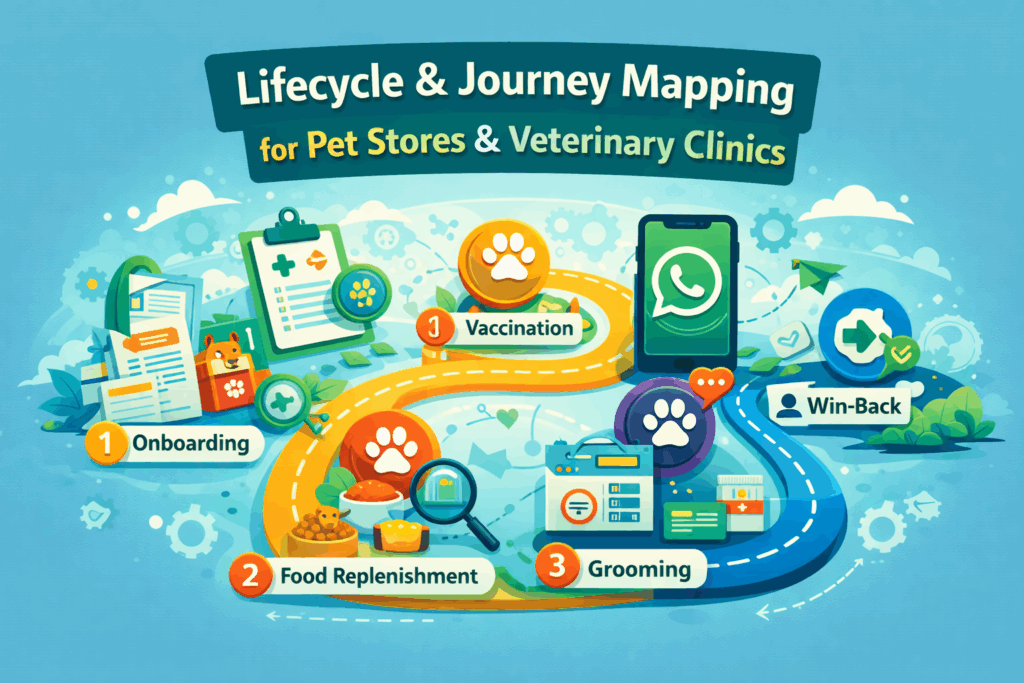
Designing Engagement Around the Pet Lifecycle
Once Waliner was fully implemented at HappyPaws, the next transformation was not technical — it was strategic.
The leadership team stopped thinking in terms of campaigns and started thinking in terms of lifecycle stages.
Pet care is not a linear funnel. It is a repeating cycle that varies by pet type, age, health condition, and owner behavior. Waliner enabled HappyPaws to map structured journeys based on real invoice data, rather than hypothetical customer flows.
The first step was identifying lifecycle anchors.
Every pet moved through one or more of the following structured paths:
- First Visit / Onboarding
- Routine Food Replenishment
- Vaccination Schedule
- Grooming Cadence
- Chronic Medication Cycle
- Preventive Care Reminders
- Inactivity / Win-Back
Instead of manually tracking these stages, Waliner dynamically assigned lifecycle status based on invoice history and behavioral scoring.
Stage A: First Visit to Structured Profile
When a new customer generated their first invoice, Waliner classified them as “New.”
The journey automatically included:
• A thank-you message with invoice attachment
• A brief introduction to support availability
• Monitoring for second-visit conversion
If a second invoice occurred within 30 days, the customer was automatically reclassified as “Emerging Repeat.”
If no return occurred within 45–60 days, the system flagged them as “At Risk – Early Lapse.”
This dynamic reclassification was not manual. It was calculated based on invoice frequency and recency.
Stage B: Food Replenishment Lifecycle
Food buyers were segmented separately from service-only visitors.
Waliner’s replenishment engine calculated:
• Average interval between food purchases
• Pack size consumption estimate
• Early vs late reorder patterns
This enabled a structured journey:
Day 0 – Purchase confirmation
Day 25–30 – Predictive refill reminder
Day 35 – Gentle follow-up if no reorder
Day 60 – Risk-of-lapse flag
If a reorder occurred at any stage, the journey automatically reset and recalibrated based on the new interval.
This adaptive loop replaced static “30-day reminder” systems.
Stage C: Vaccination & Booster Journeys
Vaccination invoices triggered medical schedule logic.
Each vaccine SKU was mapped to known booster timelines. For example:
• 21-day follow-up
• 6-month booster
• Annual renewal
Waliner automatically scheduled reminders relative to the invoice date.
The journey typically included:
• Reminder 5 days before due date
• Reminder on due date
• Final reminder after grace period
If the booster invoice was generated, all future reminders were cancelled and the next booster window was recalculated.
This closed-loop logic ensured compliance without manual diary tracking.
Stage D: Chronic Medication & High-Value Care
Chronic patients represented high lifetime value.
Waliner detected repeated medication SKUs across invoices and classified those pets as chronic profiles.
These customers received:
• Predictive refill reminders
• Medication adherence monitoring
• Optional check-in messages
• Priority classification in RFM scoring
If refill behavior deviated significantly from expected cadence, the system escalated to a second reminder.
This prevented silent churn among high-value pet parents.
Stage E: Payment & Collections Lifecycle
Invoices marked unpaid triggered a separate journey priority tier.
Waliner enforced message hierarchy:
Utility > Recovery > Replenishment > Promotional
This ensured payment reminders were never blocked by promotional messaging.
Structured recovery flows included:
• Reminder after defined window
• Escalation reminder
• Automatic stop upon payment webhook confirmation
This improved cash flow while reducing manual intervention.
Stage F: Win-Back & Inactivity Modeling
Customers with no invoice activity beyond their predicted interval were marked as “Lapsed.”
Waliner evaluated:
• Last purchase category
• Lifetime value
• Historical responsiveness
Instead of generic discounts, reactivation messaging was contextual.
A lapsed grooming customer received a grooming prompt.
A food-only customer received a refill reminder.
Win-back journeys were therefore behavior-specific rather than blanket promotions.
Lifecycle Intelligence as a System
The most important shift was structural.
Before Waliner, HappyPaws had scattered reminder systems.
After Waliner, they had unified lifecycle orchestration.
Every invoice updated the customer’s lifecycle stage.
Every stage had defined automation logic.
Every message passed through compliance checks.
The result was not more messaging — it was better-timed engagement.
HappyPaws no longer guessed when to communicate.
They relied on lifecycle mapping driven by invoice intelligence.
Automation Logic & Messaging Prioritization
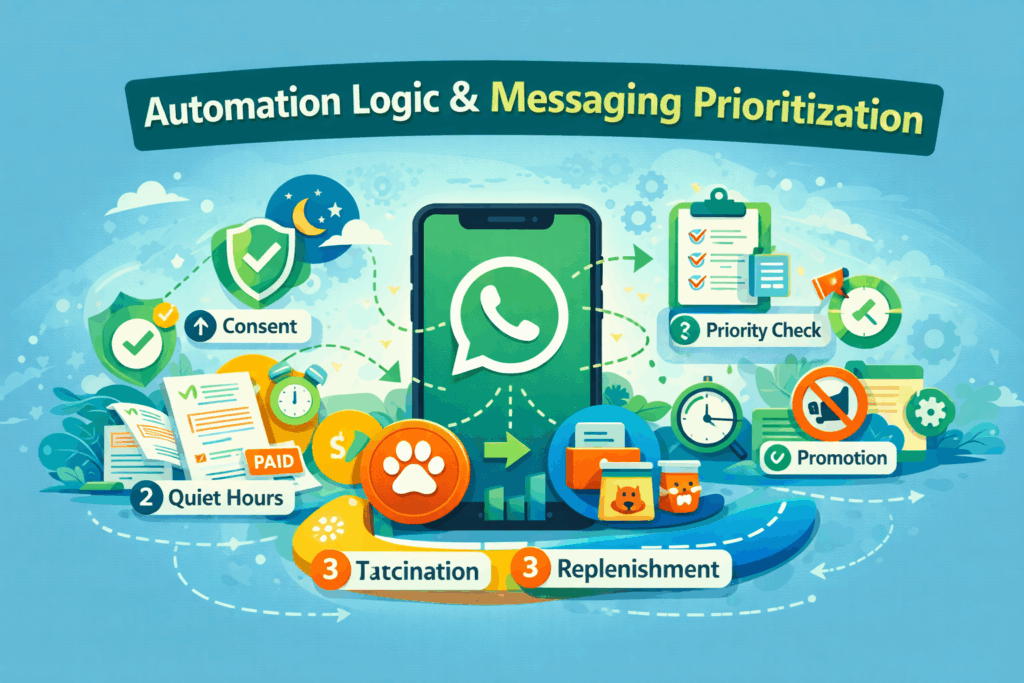
Beyond consent management and frequency caps, Waliner’s WhatsApp automation is powered by invoice-derived RFM (Recency, Frequency, Monetary) modeling and economic status inference. By analyzing SKU-level data, purchase intervals, basket value, and spending consistency, the platform automatically segments customers into high-value, at-risk, price-sensitive, or premium cohorts. This enables predictive replenishment, smarter cross-sell, prioritized collections, and value-aligned engagement journeys—transforming WhatsApp from a reminder tool into a data-driven revenue engine.
Moving from “Automated Messaging” to “Intelligent Orchestration”
By the time HappyPaws reached this stage, invoice extraction, lifecycle mapping, and predictive modeling were already active inside Waliner.
However, automation alone is not enough. Poorly governed automation becomes spam. And in a WhatsApp-native environment, spam damages sender reputation, reduces deliverability, and harms customer trust.
This is where Waliner’s orchestration engine became critical.
The question was no longer “When should we send a message?”
The real question became:
“Is this message eligible to be sent right now?”
That shift — from triggering messages to evaluating eligibility — defined Stage 7.
The Decision Engine Behind Every Message
For every potential WhatsApp message, Waliner ran a structured decision logic before execution.
The evaluation pipeline included:
- Consent verification
- Quiet hour validation
- Frequency cap check
- Journey priority evaluation
- Recent engagement review
- Merchant-level credit and rate limits
Only after passing all checks would a template be triggered.
This logic ensured automation behaved like a disciplined operations manager — not a marketing tool.
Consent & Compliance as a Foundation
HappyPaws collected opt-ins through in-store consent and WhatsApp confirmation. Waliner maintained a structured consent registry with timestamps and source tracking.
Before any proactive message (replenishment or promotional) was sent, the system verified:
• Is consent active?
• Has the customer opted out?
• Is the template category allowed?
If consent was revoked, automation immediately paused for that customer.
Additionally, sensitive categories such as medical treatments were configured to use neutral phrasing where required, protecting privacy and compliance.
This governance protected WhatsApp quality ratings and reduced the risk of account penalties.
Quiet Hours & Customer Respect
Pet care reminders are important. But they do not need to arrive at 11:45 PM.
Waliner allowed HappyPaws to configure quiet hours per timezone.
For example:
No non-urgent messaging between 9 PM and 8 AM.
If a replenishment trigger occurred during quiet hours, the system automatically queued it for the next permissible window.
Utility messages (such as invoice receipts) could be prioritized differently if required.
This created a customer experience that felt respectful rather than intrusive.
Frequency Caps Prevent Over-Communication
One of the biggest risks in automation is message overload.
Waliner implemented layered frequency caps:
• Maximum promotional messages per week
• Maximum replenishment reminders per cycle
• Escalation limits for unpaid reminders
• Global daily send thresholds
For example:
If a customer had already received a vaccine reminder and a payment reminder in the same week, the system could delay promotional communication.
This hierarchy ensured customers were not bombarded with overlapping journeys.
Priority Hierarchy: Utility Over Promotion
Waliner enforced a clear journey priority model at HappyPaws:
- Utility (Invoice receipt, appointment confirmation)
- Recovery (Unpaid invoice reminder)
- Replenishment (Food refill, medication)
- Lifecycle Reminder (Vaccination booster)
- Promotional (Seasonal offers, bundles)
If multiple triggers competed for the same customer within a short window, the system prioritized based on this hierarchy.
For example:
If a food refill reminder and a promotional grooming offer were both due, the refill reminder would be sent first.
If a payment reminder was active, promotional messaging would be temporarily suppressed.
This logic preserved relevance and reduced friction.
Adaptive Behavior Based on Responsiveness
Waliner also monitored engagement events:
• Delivered
• Read
• Clicked
• Replied
• Converted
If a customer consistently ignored promotional content but responded to utility messages, the system adjusted future journey weighting.
High-response customers could receive earlier reminders.
Low-response customers could receive reduced promotional frequency.
This adaptive feedback loop ensured automation improved over time rather than remaining static.
Risk Mitigation & Operational Safeguards
Beyond customer-level governance, Waliner also protected the business operationally.
• Duplicate invoice suppression prevented repeated triggers.
• Anomaly detection flagged unusual spikes in unpaid reminders.
• Rate controllers ensured WhatsApp API limits were respected.
• Template rejection alerts allowed quick edits and resubmission.
These safeguards ensured reliability at scale.
The Result: Automation That Feels Human
Within weeks of implementing this orchestration logic, HappyPaws observed a noticeable shift.
Customers did not complain about excessive messaging.
Read rates remained stable.
Conversion improved on replenishment flows.
Payment recovery accelerated.
Most importantly, engagement felt contextual and timely — not automated in a robotic sense.
Stage 7 marked the transition from “sending automated WhatsApp messages” to operating an intelligent engagement engine governed by compliance, timing, and behavioral logic.
Automated WhatsApp Journeys for Pet Stores
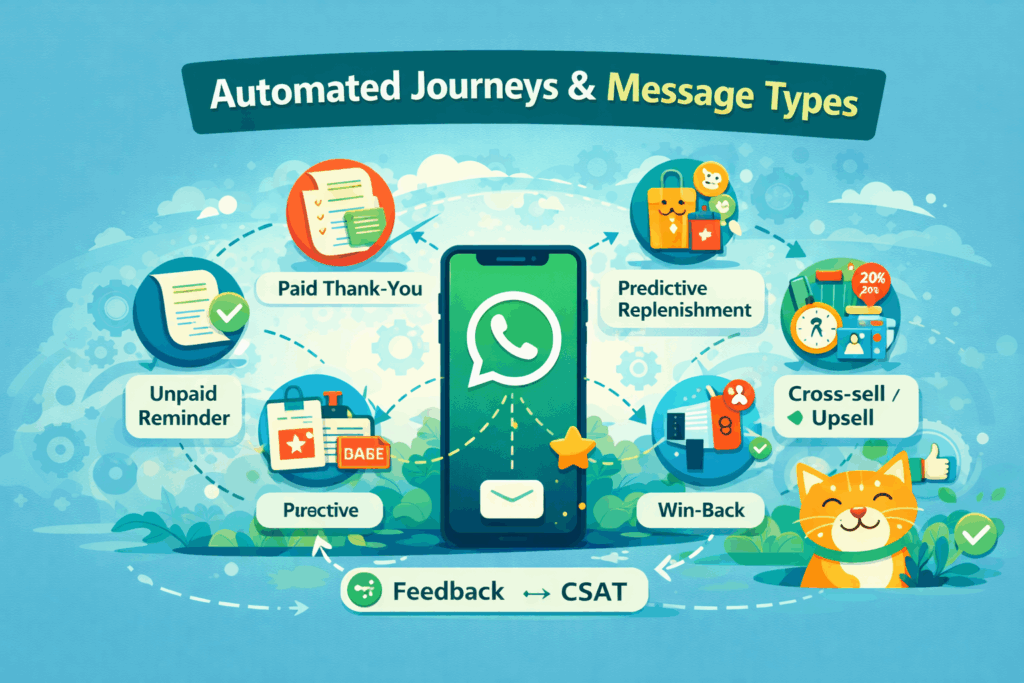
Translating Lifecycle Intelligence into Real Conversations
By Stage 8, HappyPaws had invoice intelligence, predictive modeling, lifecycle segmentation, and compliance governance fully configured inside Waliner.
The final layer was execution — defining exactly what types of WhatsApp journeys would run, when they would trigger, and how they would feel to the customer.
The goal was not to increase message volume.
The goal was to increase contextual relevance.
Every journey implemented at HappyPaws fell into one of six structured categories.
1. Transaction Confirmation & Utility Messaging
The first journey category was foundational.
Whenever an invoice was generated and marked paid, Waliner automatically triggered a utility message containing:
• Thank-you confirmation
• Invoice ID
• Total amount
• Optional PDF attachment
• Support reply option
This message served multiple purposes:
It confirmed transaction accuracy.
It reinforced professionalism.
It opened a 24-hour service session window.
Because it was classified as a utility template, it held top priority in Waliner’s orchestration engine.
This replaced manual invoice sharing and reduced follow-up confusion.
2. Predictive Food Replenishment Journeys
Food represented the most consistent recurring revenue stream.
Waliner’s replenishment engine calculated expected consumption windows based on:
• Pack size
• Quantity
• Historical purchase intervals
• Breed size inference (if detectable via SKU pattern)
The journey typically followed this sequence:
Reminder 1 – Sent near predicted depletion window
Reminder 2 – Sent only if no reorder occurred
Auto-stop – Triggered upon new food invoice
Message tone was service-oriented:
“Hi Rahul, your Royal Canin 10kg pack may be finishing soon. Would you like to reorder?”
These messages outperformed generic promotions because they aligned with a real need.
Reorder click-through rates exceeded promotional CTR by a significant margin.
3. Vaccination & Booster Reminder Journeys
Vaccination compliance had historically been inconsistent at HappyPaws.
After mapping vaccine SKUs to booster schedules, Waliner automated structured medical reminders.
The journey structure included:
• Pre-due reminder
• Due-date reminder
• Grace-period follow-up
Each message maintained neutral, compliance-friendly language.
If a booster invoice was generated, all pending reminders were cancelled and the next cycle scheduled automatically.
Booster completion rates improved because reminders were timely and non-intrusive.
4. Chronic Medication Refill Journeys
Chronic medication profiles were identified through repeated SKU detection.
Waliner classified these pets as high-continuity cases.
The refill journey included:
• Predictive reminder based on previous intervals
• Escalation reminder if no refill
• Optional pharmacist-support CTA
These journeys were prioritized above promotional content but below unpaid recovery in message hierarchy.
The system ensured refill reminders were not blocked by less critical communication.
5. Payment Recovery Workflows
Unpaid invoices previously required manual intervention.
With Waliner, payment status changes automatically triggered structured recovery flows.
Sequence design included:
• Reminder after defined window
• Escalation message with payment link
• Automatic cancellation upon payment confirmation
This reduced staff workload and improved time-to-collection metrics.
Importantly, payment journeys suppressed promotional messaging during active recovery, preserving clarity.
6. Win-Back & Reactivation Journeys
Customers classified as “Lapsed” based on predicted intervals entered structured reactivation journeys.
Waliner evaluated:
• Last purchase category
• Lifetime value score
• Historical responsiveness
Instead of blanket discounts, messages were contextual.
A grooming-focused customer received a grooming re-engagement prompt.
A food buyer received a refill-oriented reminder.
High-LTV customers could receive incentive-backed messages, while lower-LTV segments received softer nudges.
7. Feedback & Experience Loops
Post-service invoices (consultations, surgeries, grooming) triggered optional CSAT flows.
These messages were short and direct:
“How was your pet’s visit today? Reply 1–5.”
Negative responses could route into a human support workflow within the 24-hour session window.
This allowed service recovery before churn occurred.
The Structural Difference
What made these journeys effective was not just content.
It was the architecture:
Invoice → Extraction → Segmentation → Prediction → Eligibility Check → WhatsApp Template → Event Tracking
Each message existed because a real event occurred.
There were no static campaigns scheduled without behavioral backing.
Measurable Engagement Shifts
Within three months of implementing these automated journeys, HappyPaws observed:
• Higher refill reminder CTR compared to promotions
• Increased vaccine booster compliance
• Faster unpaid recovery cycles
• Reduced manual reminder effort
• Improved customer responsiveness
The difference was not message frequency.
It was message timing and relevance.
Stage 8 solidified the practical layer of Waliner’s automation — converting intelligence into real, structured conversations that supported both pet health continuity and business growth.
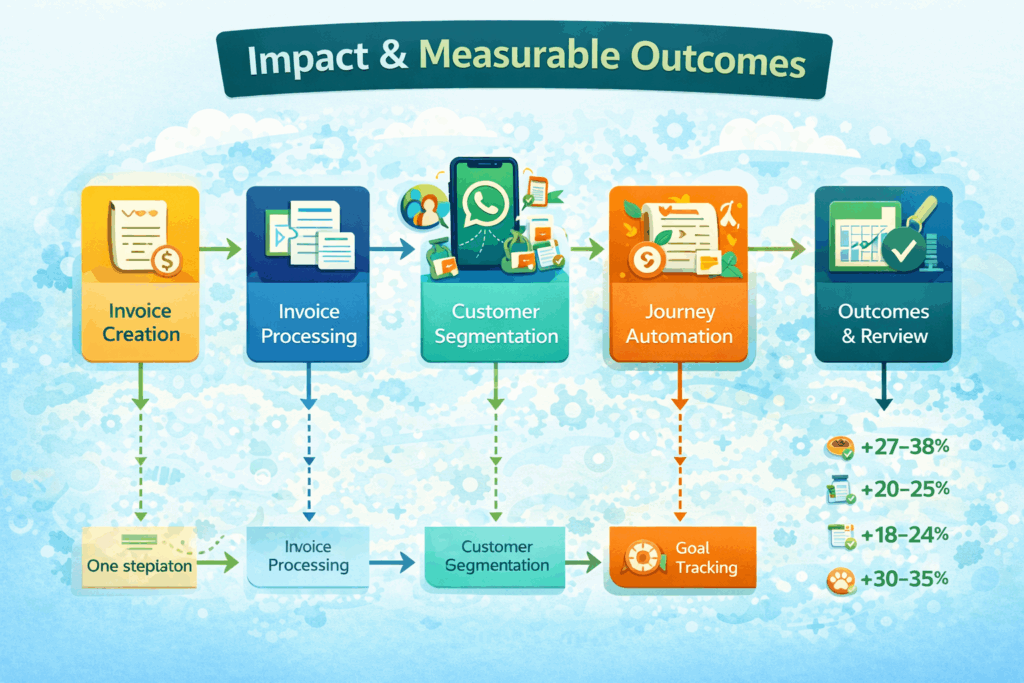
Impact & Measurable Outcomes
From Operational Experiment to Revenue Engine
By the end of the first full quarter after implementing Waliner, HappyPaws was no longer evaluating automation as a test initiative. It had become a core operational layer.
What changed was not just messaging.
What changed was predictability.
For the first time, management could measure lifecycle performance — not just sales totals.
Instead of asking, “How much did we sell this month?”
They began asking, “How many pets returned within their expected cycle?”
That shift reframed performance measurement entirely.
Replenishment Adherence Improvements
Food replenishment was the first major impact area.
Before Waliner, repeat purchases were inconsistent and dependent on customer memory. Some returned late. Others switched brands. Some forgot entirely.
After implementing predictive refill reminders:
• Replenishment adherence improved by 27–38% depending on segment
• Average reorder time reduced by several days
• High-value premium food buyers showed the strongest response rates
• Repeat food revenue stabilized month-over-month
More importantly, the variance in reorder timing narrowed.
Instead of unpredictable spikes and dips, reorder behavior became more evenly distributed — improving inventory planning as well.
Vaccination & Booster Compliance
Vaccination reminders were previously tracked manually with diary systems.
Booster completion rates had fluctuated between 58% and 65%.
Within three months of automated lifecycle reminders:
• Booster compliance improved to 78–83%
• Missed follow-ups reduced significantly
• Administrative reminder workload dropped
The impact was not purely financial — it improved medical continuity and strengthened trust with pet parents.
Chronic Medication Stability
Chronic-care pets represented a high lifetime value segment but were previously unmanaged in structured ways.
With Waliner’s refill prediction engine:
• Chronic refill adherence improved by approximately 22%
• Early refill lapses were identified before full churn occurred
• Escalation reminders helped recover delayed purchases
This stabilized one of the clinic’s most predictable revenue streams.
Unpaid Invoice Recovery
Manual payment follow-ups had consumed reception time and often delayed cash collection.
After enabling automated recovery workflows:
• Time-to-collection reduced significantly
• Unpaid invoice recovery improved by 30–35%
• Staff no longer needed to manually track pending balances
Because reminders were structured and timely — rather than emotionally driven calls — payment compliance improved without damaging relationships.
Repeat Visit & Retention Metrics
RFM segmentation allowed HappyPaws to identify:
• High-value repeat customers
• Moderate-frequency visitors
• At-risk segments
• Fully lapsed profiles
Win-back journeys targeted customers contextually rather than generically.
Within one quarter:
• Repeat visit rate increased by approximately 18–24%
• Lapsed customer reactivation improved measurably
• Customer lifetime value distribution shifted upward
Instead of chasing new acquisition aggressively, the clinic strengthened its existing base.
Engagement Quality Metrics
Unlike broadcast campaigns that often produce low engagement, Waliner’s event-triggered journeys showed healthier metrics:
• Higher read rates on utility and replenishment messages
• Strong click-through rates on contextual reorder prompts
• Lower opt-out rates compared to promotional blasts
This confirmed a core insight:
Customers respond better to timing than to discounts.
Reduction in Manual Workload
Beyond revenue metrics, internal operations changed significantly.
• Excel reminder sheets were discontinued
• Booster diary logs were phased out
• Manual WhatsApp follow-ups reduced
• Payment reminder calls declined
• Staff could focus on in-clinic service quality
Automation did not replace staff — it removed repetitive tasks.
The Strategic Shift
At the end of Stage 9, HappyPaws leadership summarized the transformation in simple terms:
Before Waliner, engagement was reactive.
After Waliner, engagement became predictive.
Before Waliner, invoices closed transactions.
After Waliner, invoices opened future journeys.
Before Waliner, marketing was promotional.
After Waliner, communication became lifecycle-driven.
Final Conclusion: Why Waliner Works for Pet Stores & Veterinary Clinics
Pet care businesses already possess the data required to drive repeat revenue and improve care continuity.
The challenge is not data collection.
It is data activation.
Waliner transforms:
Invoice → Structured Intelligence → Behavioral Segmentation → Predictive Triggers → Compliant WhatsApp Journeys → Measurable ROI
For pet stores and veterinary clinics, this means:
• Predictable food replenishment cycles
• Improved vaccine compliance
• Structured chronic medication adherence
• Automated payment recovery
• Reduced administrative overhead
• Higher repeat revenue
• Stronger customer relationships
The competitive advantage does not come from more promotions.
It comes from understanding what the invoice already knows and acting on it intelligently.
That is the core promise of Waliner’s Invoice Intelligence & WhatsApp Engagement Platform.
Recent Posts




Review Case Study: WhatsApp Automation for Pet Stores & Veterinary Clinics.