WALINER CASE STUDY: GROCERY, SUPERMARKET AND FMCG INDUSTRY
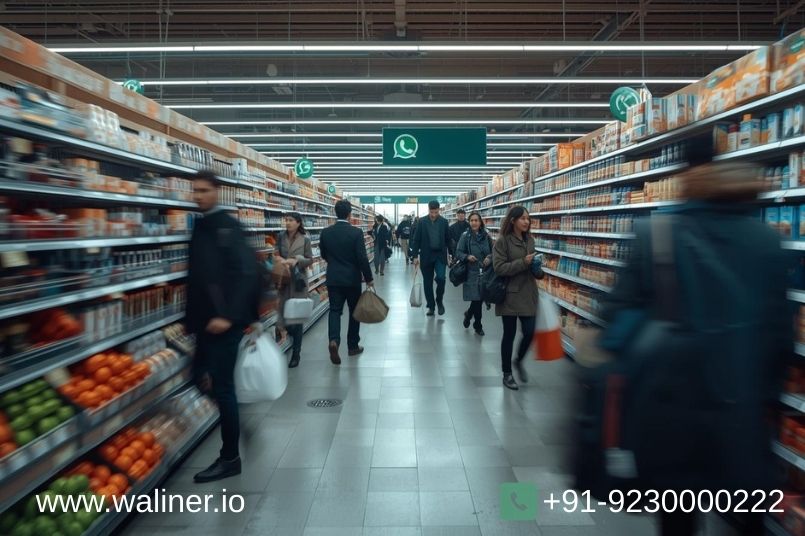
WhatsApp automation for supermarkets now makes it possible for stores to act on predictable buying cycles the moment they appear inside everyday invoices. Grocery retail runs on established household routines, families buy milk, bread, staples, and essentials on highly consistent schedules, and their behaviour rarely changes. These patterns are already visible in every invoice through item choices, quantities, and natural consumption cycles.
Retailers can predict future sales and determine when customers will return and build stronger customer relationships through the analysis of this purchase data. The system developed by Waliner detects customer behavior patterns which it uses to create relevant customer contact at the right time. The system helps supermarkets build new customer relationships while boosting customer return rates and business expansion through automated operations instead of using discounts or human involvement.
1. Industry Background and Core Problem
Supermarkets run on predictable household buying cycles—milk every few days, bread weekly, staples monthly, cleaning items each quarter. These patterns never change, but stores rarely act on them.
Customers begin drifting away quietly: weekly buyers miss cycles, basket regulars shift to other stores, and loyal families stop returning. All the signals sit inside the invoices—items, quantities, purchase rhythm, payment status—but the retailer has no system that converts this data into insights or action.
Stores struggle with three recurring issues:
- No prediction of replenishment cycles
- Declining repeat visits
- No item-level personalization or segmentation
Waliner resolves this gap by transforming every invoice into behavioural intelligence and timing-based engagement.
2. Why Traditional Tools Failed
POS systems and loyalty programs store customer data but cannot interpret it. They record items but cannot predict when a family will need milk again, when a basket pattern breaks, or when a regular shopper begins to lapse.
Traditional tools fail because:
- Data is stored, not analyzed
- Messages are generic, not behaviour-driven
- No replenishment intelligence exists
- Staff rely on manual list-making
- No automation scales beyond a few hundred customers
Without prediction and automation, reminders reach customers at the wrong time, targeting is inaccurate, and engagement becomes ineffective.
3. Waliner’s Workflow: How the System Actually Works
Waliner begins its solution to the grocery problem by utilizing existing retailer resources starting with their invoice data to create a complete intelligence system. The system operates without requiring any integration work or IT assistance. The store can solve this problem by using WhatsApp templates to send invoices or by uploading PDF files through the portal.
The system activates its operations after this point.
Step 1: Ingestion
The system allows users to receive invoices through WhatsApp or by using a basic drag-and-drop interface. The system operates without any integration fees and it does not require POS system changes or system dependencies. The system enables easy supermarket onboarding for businesses of every size because it eliminates complex setup processes.
Step 2: Pre-processing
Waliner performs visual cleaning of the invoice. The system fixes visual distortions while it adjusts light levels and removes digital noise and separates multiple batches and makes each page ready for data extraction.
Step 3: OCR Extraction
The system extracts all data from the invoice table together with item names and quantities and prices and taxes and payment status and categories and timestamps and any additional notes. The system handles different invoice layouts because it was designed to accommodate various formats.
Step 4: Item and Category Mapping
The system organizes all SKUs into a systematic classification system which includes staples and dairy products and bakery items and household goods and personal care products and beverages and snacks and packaged foods and fresh produce. The classification system helps organizations understand customer purchasing patterns.
Step 5: Customer Entity Mapping
Waliner normalizes phone numbers, merges duplicates, and ensures each household has a single unified profile.
Step 6: Customer Profiling and RFM Scoring
Customers are evaluated based on:
- Recency of purchase
- Frequency of purchase
- Total spend
This creates a clear hierarchy of high-value customers, families with predictable patterns, price-conscious shoppers, weekly regulars, and at-risk customers.
Step 7: Replenishment Prediction
This is the heart of Waliner’s intelligence.
Every item purchased is assigned a consumption cycle based on:
- Industry-known consumption intervals
- Household size
- Quantity purchased
- Past return behaviour
For example:
- Milk: every two or three days
- Bread: once or twice a week
- Eggs: weekly
- Household cleaning items: every 20 to 40 days
- Rice: every 45 to 90 days
The system quietly builds a calendar of when each household is expected to need things again.
Step 8: Trigger Evaluation
When a predicted need approaches, Waliner checks:
- Consent
- Frequency limits
- Quiet hours
- Existing journeys
- Priority of message type (utility first, replenishment next, promotions last)
Step 9: Personalised WhatsApp Templates
The messages maintain a natural human touch in their delivery. The system presents purchase details to customers through gentle reminders at their most convenient time.
Examples:
“You bought one litre of milk two days ago. Would you like to restock today?”
“Your monthly rice pack might be running low. Want us to prepare a quick reorder link?”
Step 10: Event Tracking
The system tracks delivery performance and reading activities and click behavior and reply responses and conversion rates while using each interaction to enhance its predictive accuracy.
The store progresses from sending basic promotions to delivering specific messages at appropriate times which bring value to customers.
4. Journeys Used for Grocery Retail
The automation library of Waliner contains journeys which follow typical shopping patterns of grocery customers.
A. Thank-you and Receipt Confirmation
The system sends this message right after someone makes a purchase. The message confirms the order while it sends subtle alerts about upcoming reminders. The system shows customers attention without displaying any promotional content.
B. Predictive Replenishment
The supermarket operates this system as its version of a “never run out” program.
The system tracks customer shopping patterns to predict their future shopping dates.
The system sends customers alerts about their upcoming shopping trips based on their purchase history.
The system sends regular reminders to customers who need diapers every month.
C. Basket Recreation (Weekly Routine Shopping)
Every Friday afternoon, many families stock up for the weekend.
Waliner sends a message that mirrors the family’s usual pattern.
“Your regular basket is ready for quick reorder.”
This dramatically reduces the friction of browsing.
D. Cross-sell and Adjacency Suggestions
When someone buys tea, the system suggests biscuits.
When someone buys shampoo, it suggests conditioner.
When someone buys snacks, it highlights beverages.
The suggestions feel natural because they match habits.
E. Win-back for Broken Cadence
Every grocery store experiences customers who leave without notice.
Waliner detects this almost immediately.
A customer who used to shop weekly but has not returned in ten days receives a gentle, personalised invitation.
“We noticed you have not picked up your usual items this week. Would you like us to prepare a basket for you?”
F. Unpaid Invoice Follow-up
The system sends a basic polite payment reminder to customers only when their payments become due.
5. Impact and Measurable Results
The implementation of Waliner’s grocery intelligence system produces measurable results which become apparent during the initial month of operation.
A. Strong Increase in Repeat Purchases
Customers will return more frequently when reminders reach them during the right time.
The weekly and bi-weekly customer traffic at grocery stores experiences a major increase.
B. Dramatic Improvement in Replenishment Cycles
Customers stop forgetting essential items.
Merchants report that families show better consistency when buying staple products.
C. More Items Per Basket
The process of cross-selling leads customers to increase their average order value naturally.
People who purchase milk products tend to select bread as an additional item.
Customers who purchase diapers tend to select wipes and lotion as additional items during their purchase.
Customers who purchase tea products tend to select snacks as their additional item.
D. Clear Revival of Lapsed Customers
Waliner detects when regular customers miss their scheduled visits by more than a day before sending them a considerate reminder message. The nudge helps customers return to the business before they develop new shopping habits at different locations.
E. Far Lower Operational Workload
Teams now operate without the need to create lists or export spreadsheets or perform manual follow-up tasks.
Staff members can dedicate their time to service delivery because they no longer need to handle messaging work.
F. Reduction in Churn
The combination of replenishment tracking with cadence protection and early-warning win-backs leads to a substantial reduction in customer loss rates.
G. Higher Recovery of Unpaid Bills
The system enables customers to settle outstanding amounts through instant payment links which helps complete transactions more quickly.
The system achieves its improvements through customer rhythm understanding and timely presence rather than using forceful marketing strategies.
6. Compliance and Safety
Waliner maintains strict compliance standards because grocery retail operates as a high-frequency industry.
- The company uses only authorized WhatsApp templates for all its outgoing messages.
- The system maintains quiet hours which prevent customers from receiving messages during late evening hours.
- The system limits the number of messages sent to customers through frequency caps.
- Utility messages receive higher priority than promotional content in all cases.
- Customers maintain full control to unsubscribe from messages at any time.
The consent registry system maintains customer permissions for all messages sent through the system.
7. Conclusion: Why Waliner Works So Well for Grocery
The basic operations of grocery retail do not involve complex problems. The industry operates through continuous execution of basic requirements which occur repeatedly. The sector operates through established patterns which include regular routines and forecastable events. The milk purchasing pattern of families continues because they need to purchase it repeatedly. The monthly diaper purchase of parents will continue because they need to buy them again during the following month. The patterns in customer behaviour remain obvious yet retailers lack a system which understands their buying habits.
The system converts financial documents into active records which track customer actions throughout time. Every transaction generates valuable information for analysis. Every product stock-keeping unit (SKU) operates as a recurring pattern. The company understands all domestic customers through their purchasing patterns.
The system enables better delivery timing and improved customer interactions and streamlined shopping experiences and a store that delivers personal attention instead of basic transactions.
The system produces outstanding results because it helps customers feel remembered by retailers who use intelligent operations to drive business expansion through purposeful customer interactions.
Waliner enables supermarkets to develop authentic customer loyalty through their ability to analyze individual purchase records from invoices.
30-Day Automation Rollout Plan for Grocery / Supermarket / FMCG
Waliner’s automation setup progresses swiftly, with each stage designed to help the model understand your customer behaviour using historical invoices.
Phase 1 — Foundation Setup
Waliner quickly reviews how your invoices are structured, how your store bills customers, and what your typical sales rhythms look like. A small batch of past invoices is ingested so the pretrained model can familiarise itself with your patterns and SKU variations.
Essential WhatsApp templates are reviewed and approved early in the process, and your team learns the simple workflow of forwarding invoices through WhatsApp—no technical training required.
Phase 2 — Turning Invoices into Customer Profiles
Once live invoices begin flowing in, the system swiftly builds customer profiles based on repeat behaviour, category affinity, and spend patterns.
RFM segmentation becomes active, creating groups such as weekly buyers, monthly shoppers, high-value families, and at-risk customers.
You also start seeing early insights on category performance and purchasing cadence.
Phase 3 — Core Automations Go Live
Waliner begins sending thank-you messages, replenishment nudges, and personalized cross-sell suggestions.
The model continuously adapts as it ingests more past invoices, refining replenishment cycles and adjusting timing based on real purchase behaviour.
Customers start experiencing timely, relevant WhatsApp interactions that mirror their natural shopping rhythm.
Phase 4 — Optimization, Win-Back, and Scaling
As automations run, Waliner identifies lapses in customer cadence and quickly activates win-back messages.
Basket recreation reminders and category recommendations become more accurate as the model learns from historical purchase intervals.
You gain deeper analytics on repeat purchases, SKU-level lift, cross-sell behaviour, and customer retention.
Outcome
Within a short period, the store transitions into a behaviour-aware, invoice-driven engagement engine.
Customers feel remembered, staff workload decreases, and purchase cycles become more predictable, powered entirely by invoice intelligence.
Recent Posts





Review WALINER CASE STUDY: GROCERY, SUPERMARKET AND FMCG INDUSTRY.