WhatsApp Automation for Fashion, Apparel & Footwear Brands
Industry Background & Core Problem
Whatsapp automation for fashion brands is an important step today’s digital world. Fashion, apparel, and footwear retail do not operate like most other consumer businesses. Buying behavior is irregular, emotional, and heavily influenced by timing, trends, and personal confidence. A customer does not “need” a dress the way they need groceries or medicine. They buy when something feels right, when the style aligns, the season matches, the fit seems safe, and the moment feels justified.
This makes WhatsApp Automation for Fashion Brands fundamentally different from automation in other verticals.

How fashion buying works
Fashion purchases are driven by a mix of planned intent and impulse. Seasonal shifts, summer, festive periods, wedding months, end-of-season sales, create spikes in demand. Within those spikes, customers buy selectively. One kurta, one pair of sneakers, one jacket. Rarely a full wardrobe.
Fit and size confidence play an outsized role. A customer may love the design but hesitate because they are unsure how it will fit. When the first purchase works, trust is built. When it doesn’t, churn is silent and immediate. Unlike electronics or services, customers rarely complain. They just don’t come back.
Footwear adds another layer of sensitivity. Comfort, sizing accuracy, and usage context matter more than brand messaging. A great first experience can lead to repeat buying. A slightly off fit can end the relationship.
Across apparel and footwear, most brands face the same structural reality:
- A large percentage of customers buy only once
- Repeat purchase cycles are unpredictable
- Attachment opportunities (belts, socks, bags, dupattas, care products) are often missed
- Engagement drops sharply after the invoice is generated
The post-purchase silence problem
Once a purchase is completed, an invoice is created, payment is captured, and the system moves on. From the brand’s side, the transaction is “done.” From the customer’s side, this is the most important moment.
This is when they are evaluating:
- Was the size right?
- Did the product meet expectations?
- Would I buy from this brand again?
Yet this is also when most fashion brands go silent, or worse, become irrelevant.
Some brands over-message. They send generic WhatsApp broadcasts: sales, new arrivals, discounts. These messages ignore what the customer bought, what size they wear, or whether they are even ready to shop again. WhatsApp starts to feel noisy.
Other brands under-communicate. They send only an order confirmation and disappear until the next sale. By then, the customer has moved on.
In both cases, the invoice exists. The data exists. But it is unused.
The real business impact
This gap between purchase and engagement creates measurable problems:
- Low repeat purchase rates
Customers who had a neutral or even positive first experience are not guided back at the right time. - Missed attachment revenue
Footwear without socks, outfits without accessories, ethnic wear without add-ons, lost not because of pricing, but because of timing and relevance. - Overdependence on discounts
With no lifecycle intelligence, brands fall back on sales to re-trigger demand, eroding margins. - WhatsApp fatigue
When messaging is generic, customers mute, ignore, or opt out damaging long-term channel quality.
Fashion brands do not have a messaging problem. They have a lifecycle understanding problem.
Why WhatsApp automation must change in fashion
In fashion, WhatsApp cannot behave like a campaign tool. Campaign-led thinking assumes that the same message can be pushed to everyone at the same time. That logic breaks down in a category where relevance depends on what was bought, in which size, during which season, and how recently.
WhatsApp Automation for Fashion Brands must be lifecycle-led, not campaign-led.
It must start from real purchases, not assumptions. From invoices, not broadcast lists. From customer context, not promotional calendars.
Only then does WhatsApp become useful instead of noisy and only then does it drive repeat buying instead of silent churn.
Why Traditional Tools Fail in Fashion
Most fashion brands already use some combination of POS systems, CRMs, and WhatsApp broadcast tools. On paper, this looks sufficient. Transactions are recorded, customers exist in a database, and messages can be sent at scale. In practice, these tools consistently fail to drive repeat buying or meaningful WhatsApp engagement in fashion.
The failure is not technical. It is contextual.

CRMs don’t understand how fashion decisions are made
Traditional CRMs are built to store static attributes: name, phone number, last purchase date, total spend. At best, they might tag a customer as “men’s wear” or “women’s wear.”
What they do not understand is:
- What category the customer actually bought (ethnic vs casual vs footwear)
- What size they wear—and whether that size purchase was recent or one-off
- Whether the purchase was seasonal, occasion-led, or experimental
- Whether the customer is confident enough to buy again without reassurance
A CRM may know that a customer bought “once in July.” It does not know that they bought a festive kurta in size M during a sale, and that messaging them about winter jackets two weeks later is irrelevant.
Fashion relevance is contextual and time-bound. CRMs are static.
Broadcast WhatsApp tools flatten every customer into the same message
Most WhatsApp tools used by fashion brands are broadcast-first. They are optimized for sending messages, not for deciding who should receive what, and when.
As a result:
- First-time buyers receive the same promotions as loyal customers
- Someone who just bought footwear is pushed apparel discounts the next day
- Size-sensitive customers are messaged without any size or fit context
- Seasonal buyers are targeted outside their buying window
These tools ignore lifecycle stage completely. They do not distinguish between:
- A customer who just completed their first purchase
- A customer who is evaluating fit and quality post-delivery
- A customer who is ready for an attachment or repeat buy
- A customer who has quietly churned
Time-based blasts replace behavior-based communication. In fashion, that mismatch kills engagement.
POS systems record transactions but stop there
POS systems are excellent at one thing: completing a sale. They generate invoices, capture payment, manage inventory, and close the loop operationally.
But once the bill is printed or the PDF is generated, the POS is done.
It does not:
- Interpret what the items mean in a lifecycle context
- Track category or size sensitivity over time
- Signal whether this was a first, repeat, or high-value purchase
- Trigger any post-purchase engagement beyond a receipt
The most valuable data—the invoice line items that explain what was bought—is never used to drive customer communication. Fashion brands end up with rich transactional data and poor engagement outcomes.
Manual tagging and campaign logic collapse at scale
Some teams attempt to compensate by manually tagging customers or creating segmented lists: “Footwear buyers,” “Festive buyers,” “High spenders.”
This approach breaks down quickly:
- Tags are applied inconsistently or too late
- Lists become outdated within weeks
- Staff cannot keep up with daily transaction volume
- Segmentation becomes opinion-driven instead of data-driven
Fashion catalogs change fast. So do seasons, styles, and customer intent. Manual logic cannot keep pace with this dynamism.
Fashion buying is emotional; tools are mechanical
At its core, fashion purchasing is emotional and situational. Customers buy because something resonates in a moment. The follow-up communication must respect that moment.
Existing tools treat fashion like any other retail category:
- Same reminders
- Same offers
- Same timing
- Same logic
This is why WhatsApp messaging in fashion often feels intrusive instead of helpful.
The inevitable outcome
When tools fail to understand context, brands fall back on what is easiest:
- More campaigns
- More discounts
- More noise
Time-based or campaign-based WhatsApp messaging does not work in fashion because it ignores the customer’s actual journey. Without understanding what was bought, why it was bought, and where the customer is in their lifecycle, automation becomes spam.
Fashion does not need more messages.
It needs better triggers.
How Real Fashion Events Trigger WhatsApp Automation
In fashion, meaningful automation does not start with campaigns or calendars. It starts with real events, things that happen in a customer’s buying journey. The moment automation responds to those events; WhatsApp stops feeling like marketing and starts feeling like service.
This distinction is critical for WhatsApp Automation for Fashion Brands.
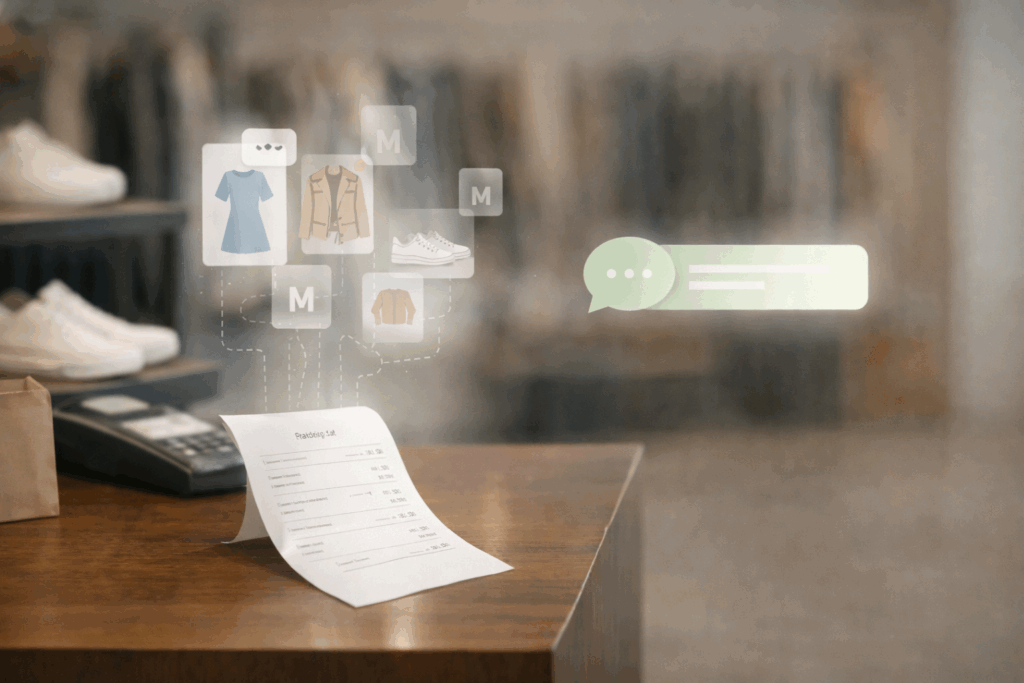
Purchases are the strongest signal stronger than browsing
Browsing data is noisy in fashion. Customers explore styles aspirationally. They save items they never buy. They scroll without intent. Triggering WhatsApp messages off browsing behavior often leads to premature or irrelevant communication.
A completed purchase, on the other hand, is a clear signal. It answers several questions immediately:
- The customer trusted the brand enough to transact
- The category and style resonated
- A size decision was made
- A price threshold was accepted
This is why effective WhatsApp automation in fashion must anchor itself to purchase events, not browsing events.
Apparel and footwear purchases as primary triggers
When a customer buys apparel or footwear, that single transaction creates multiple downstream opportunities—if interpreted correctly.
For example:
- A kurta purchase signals a potential festive or occasion-led need
- A casual shirt purchase suggests lifestyle or daily-wear intent
- A sneaker purchase implies comfort, sizing sensitivity, and usage context
Automation should not ask, “What do we want to promote next?”
It should ask, “What does this purchase tell us about the customer right now?”
Size-specific orders change the conversation
Size is one of the most overlooked but powerful triggers in fashion automation.
A customer who buys size S once is different from a customer who buys size S repeatedly. One may be experimenting. The other is confident. That difference should affect:
- When you follow up
- What you suggest next
- Whether reassurance or discovery is more appropriate
WhatsApp automation triggered by size-specific orders can:
- Time fit-confidence messages correctly
- Avoid pushing incompatible products
- Build trust before attempting repeat or attachment journeys
Generic messaging ignores this nuance. Event-driven automation respects it.
Category context matters more than brand context
Fashion customers often shop by category, not brand loyalty—especially in multi-category stores.
A customer who bought ethnic wear is not in the same mindset as someone who bought footwear, even if they bought from the same brand. Triggering WhatsApp journeys based on category-specific buying, ethnic, casual, footwear, innerwear, keeps communication aligned with intent.
This prevents a common mistake: assuming brand affinity when only category affinity exists.
Seasonal purchases are events, not just dates
Seasonality in fashion is not calendar-based; it is purchase-based.
Two customers may shop in the same season for different reasons:
- One for an upcoming wedding
- Another for daily wear during weather change
The season becomes relevant only after the purchase is understood. WhatsApp automation should react to:
- What was bought this season
- Whether the customer has bought in similar seasons before
- Whether this looks like a one-time need or a recurring pattern
Seasonal relevance triggered by real transactions is far more accurate than scheduled festive blasts.
Repeat, high-value, and payment-related events
Not all triggers are about promotion.
- A repeat purchase signals rising trust and opens loyalty or early-access journeys
- A high-value order justifies white-glove communication and reassurance
- A pending or unpaid transaction requires timely, utility-first messaging
These events demand different tones and priorities. Treating them all as “campaign audiences” flattens their meaning.
The core principle
WhatsApp automation in fashion should respond to what customers bought, not what brands hope they might buy.
Invoices are not just receipts. They are event logs of intent, confidence, and timing. When automation is triggered by these real events, relevance becomes natural and engagement follows.
WhatsApp Automation Without Changing Store or POS Workflows
One of the biggest misconceptions around WhatsApp automation in fashion is that it requires operational change. New POS integrations. Staff retraining. Process redesign. For most fashion brands especially multi-store, franchise-led, or high-volume operations—this is a non-starter.
The reality is simpler: effective WhatsApp automation can be activated without touching how stores already work.
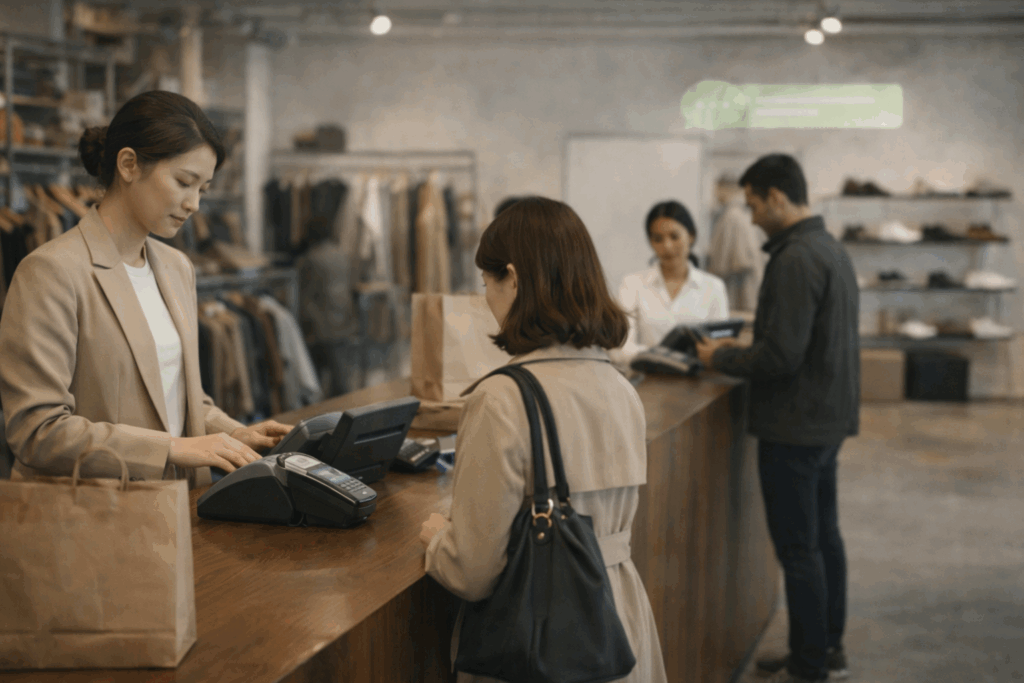
Fashion operations are already optimized for selling, not engagement
Fashion retail teams are trained to:
- Close sales quickly
- Handle size and style questions in-store
- Process billing efficiently
- Move inventory during seasonal peaks
Their workflows are transactional by necessity. Asking them to add new steps, tags, or systems during checkout creates friction and slows down operations. This is why engagement initiatives often fail at the store level—they compete with revenue-critical tasks.
For WhatsApp automation to work in fashion, it must sit after the sale, not inside it.
Invoices are the only consistent, universal input
Across brands, formats, and store sizes, one thing is always generated: an invoice.
Whether it comes from:
- A large ERP-backed POS
- A local billing system
- A franchise-specific setup
- An online order system
The invoice already contains everything needed to trigger lifecycle-led WhatsApp journeys:
- Customer phone number
- Items purchased
- Categories
- Sizes (often embedded in item descriptions)
- Order value
- Payment status
- Date and time
Crucially, this data exists without asking store staff to do anything extra.
Zero change to POS, zero disruption to staff
WhatsApp automation becomes scalable in fashion only when:
- Store teams continue billing exactly as they do today
- No new buttons, tags, or fields are introduced
- No manual list uploads are required
- No training is needed beyond existing invoice handling
Automation systems that rely on “mark this customer as X” or “select a campaign audience” fail because they assume operational discipline that retail environments cannot maintain consistently.
Invoice-led automation removes that dependency entirely.
Why this matters for multi-store and high-volume brands
Fashion brands with multiple outlets face additional complexity:
- Different store managers
- Variable staff quality
- Inconsistent tagging habits
- Peak-hour pressure during sales and weekends
Any engagement system that depends on human input at the store level will degrade over time. Automation must be centralized, not distributed.
By activating WhatsApp journeys from invoices:
- All stores feed into one consistent logic
- Customer experience remains uniform across locations
- Engagement quality does not depend on individual staff behavior
This is especially critical for footwear and apparel brands where brand perception is shaped across touchpoints, not just at checkout.
Automation should respect how fashion retail works
Fashion retail is fast, seasonal, and people-driven. The best automation respects that reality instead of fighting it.
When WhatsApp automation works silently in the background using data that already exists, it enhances customer experience without burdening operations. That is the only model that scales sustainably in fashion.
From Raw Transactions to Actionable WhatsApp Journeys
In fashion, the difference between noisy messaging and meaningful automation lies in what happens after a transaction is recorded. An invoice by itself is just a receipt. But when interpreted correctly, it becomes a decision layer.
The goal of WhatsApp Automation for Fashion Brands is not to send more messages. It is to make better decisions about who should hear from the brand, why, and when.
Raw transactions are not insights
Every fashion brand already has transaction data. Thousands of invoices flow through stores and online systems every month. Yet most of this data remains unused for engagement because it is treated as a flat record:
- Customer bought something
- Amount paid
- Date of purchase
This view is too shallow to support lifecycle-led communication.
To drive relevance, raw transactions must be reorganized into behavioral signals.
Structuring fashion purchase data
The first step is understanding what the invoice contains beneath the surface.
Each transaction can be broken down into:
- Category: apparel, footwear, accessories, innerwear, ethnic, casual
- Sub-intent: occasion wear vs daily wear, trend-led vs essentials
- Size information: explicit or inferred from SKU descriptions
- Seasonal relevance: time-bound vs evergreen items
- Customer context: first-time vs returning, low vs high value
None of this requires guessing. It comes directly from what was purchased and when.
Understanding size sensitivity and confidence
Size is not just a product attribute; it is a behavioural signal.
A first-time buyer purchasing a size once carries uncertainty. A returning buyer purchasing the same size multiple times signals confidence. This distinction affects:
- How soon the brand should follow up
- Whether reassurance or discovery messaging is appropriate
- How aggressively attachments or repeats should be suggested
Without structuring transactions around size behavior, WhatsApp automation risks pushing customers before trust is established.
Seasonal relevance is transactional, not calendar-based
Fashion seasons are often defined internally by marketing teams. Customers experience them differently.
A winter jacket purchased in October means something very different from one purchased in January clearance. Transaction timing helps determine:
- Whether the purchase was need-driven or opportunistic
- How long relevance is likely to last
- When a follow-up would feel natural versus forced
By anchoring automation to transaction timing, brands avoid premature or stale messaging.
New, returning, and at-risk customers are not the same audience
Once transactions are structured, customers naturally fall into lifecycle states:
- New buyers who need confidence reinforcement
- Returning buyers who are open to expansion or loyalty
- High-value customers who expect restraint and relevance
- At-risk customers whose silence signals disengagement
Each state demands a different WhatsApp intent. Treating them as one broadcast list guarantees irrelevance.
Decision-making over message volume
The most important shift is philosophical.
Automation is not about filling a WhatsApp calendar. It is about making fewer, better decisions:
- Is this customer eligible to hear from us now?
- Does this purchase justify a follow-up?
- Is the intent utility, reassurance, or discovery?
When raw transactions are transformed into structured understanding, WhatsApp journeys become a natural extension of the buying experience—not an interruption.
Lifecycle & Journey Mapping for Fashion Customers
Fashion customers do not move through a neat funnel. They move through states of confidence, relevance, and intent. Lifecycle-led WhatsApp automation recognizes these states and adapts communication accordingly.
This is where WhatsApp Automation for Fashion Brands becomes precise instead of promotional.
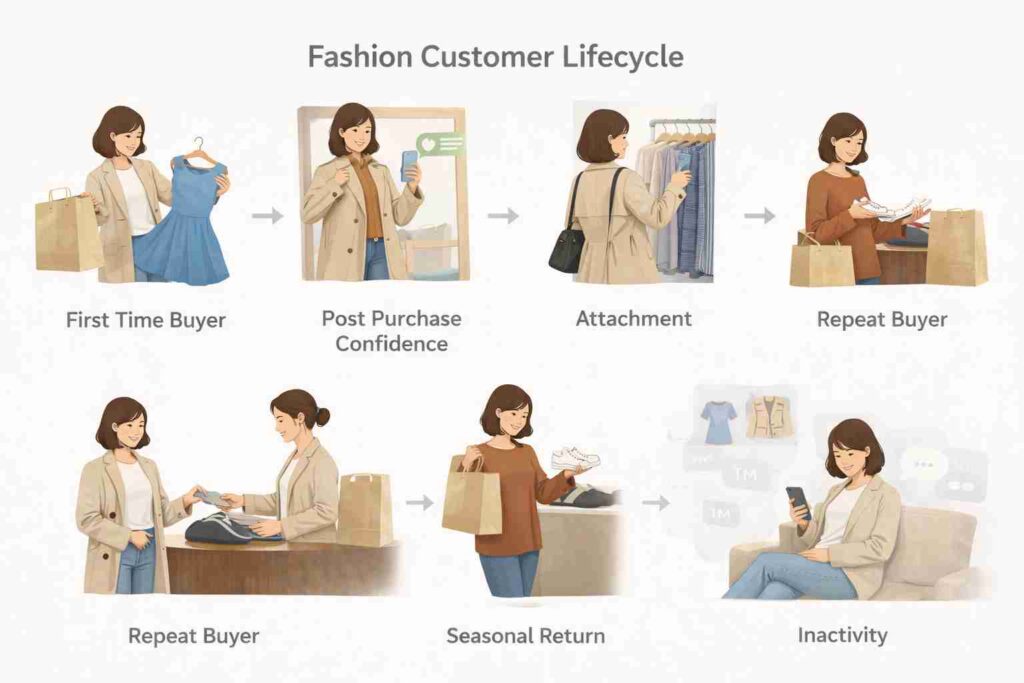
The fashion customer lifecycle is behavioral, not chronological
Most brands define lifecycle stages by time: Day 0, Day 7, Day 30. In fashion, time alone is misleading. A customer who bought yesterday may already be disengaged. Another who bought a month ago may still be in an active consideration window.
Lifecycle mapping must therefore be grounded in what the customer has experienced since the purchase, not just how many days have passed.
Stage 1: First-time buyer
This is the most fragile stage in fashion.
A first-time buyer is not loyal. They are evaluating:
- Fit and comfort
- Fabric quality
- Delivery experience
- Whether the brand matches expectations
The WhatsApp intent here is reassurance and clarity, not selling.
Messages at this stage should:
- Confirm the order clearly
- Set delivery expectations
- Reduce anxiety, especially around size and returns
- Stay minimal and utility-led
Any premature promotional message at this stage increases churn risk instead of conversion.
Stage 2: Post-purchase confidence window
Once the product is delivered and tried, a short window opens. This is when the customer subconsciously decides whether the brand is “safe” to buy from again.
This window is critical and often wasted.
WhatsApp intent here is confidence reinforcement:
- Gentle check-ins that feel optional, not intrusive
- Size or fit-related follow-ups where relevant
- Support visibility without forcing conversation
If this stage is handled well, the customer transitions naturally into repeat potential. If ignored, silence sets in.
Stage 3: Attachment opportunity
Attachment is not upselling pressure. It is contextual completion.
A customer who bought:
- Footwear may need socks or care products
- Ethnic wear may need accessories
- Casual wear may need complementary basics
This stage should only activate after confidence is established. The intent is discovery, not discounting.
Timing matters more than offer value. A relevant suggestion sent once is more effective than repeated promotions sent too early.
Stage 4: Repeat buyer
Repeat buyers behave differently. They:
- Trust the brand more
- Need less reassurance
- Expect better relevance and restraint
WhatsApp intent here is recognition and continuity:
- Acknowledge returning behavior implicitly
- Suggest based on known category or size preferences
- Avoid over-communication
For repeat buyers, fewer messages with higher relevance outperform frequent engagement.
Stage 5: Seasonal reactivation
Fashion is seasonal, but customers are not always predictable.
Seasonal reactivation works only when:
- It aligns with past purchase categories
- It respects buying cadence
- It does not assume universal interest
The intent is timely relevance, not urgency. Customers should feel reminded, not chased.
Stage 6: Inactive or churn-risk customers
Silence in fashion is subtle. Customers rarely unsubscribe. They just stop responding.
Churn-risk identification comes from:
- No repeat purchase within expected category cycles
- Ignored previous messages
- One-time, occasion-led buying behavior
WhatsApp intent here is low-pressure re-entry:
- One clear, respectful attempt
- No aggressive discounts
- Easy opt-out or silence acceptance
Pushing harder at this stage damages brand perception.
Mapping intent, not just journeys
Each lifecycle stage maps to a different WhatsApp intent:
- Utility
- Reassurance
- Discovery
- Recognition
- Reminder
- Re-entry
When journeys are designed around intent instead of campaigns, automation feels human—even at scale.
Automation Logic, Prioritization & WhatsApp Compliance
In fashion, trust is fragile. Customers tolerate WhatsApp messages only as long as those messages feel expected, relevant, and respectful. Once that balance is broken, opt-outs rise quietly, messages get ignored, and the channel loses its value.
This is why WhatsApp Automation for Fashion Brands must be governed by logic and prioritization not just triggers.
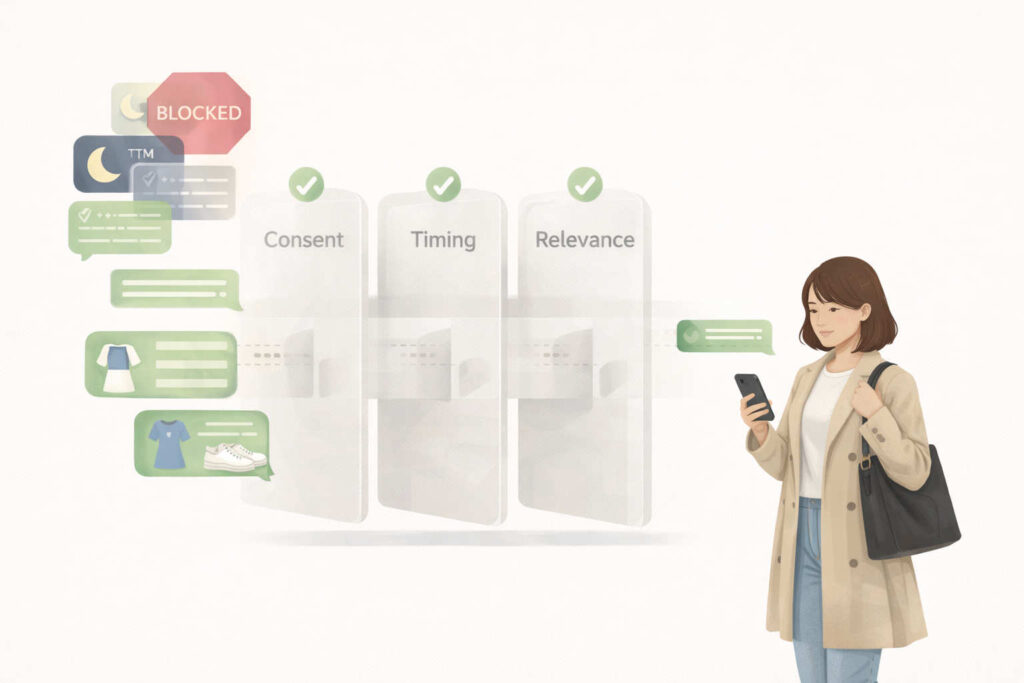
Consent is not a checkbox, it is a gate
Every automation decision begins with consent.
Fashion brands often assume that a phone number on an invoice equals permission to message. That assumption is dangerous. Sustainable WhatsApp engagement requires:
- Explicit opt-in capture (online, in-store, or via prior interaction)
- Clear linkage between consent and message type
- Immediate suppression when a customer opts out
Automation should never “try its luck.” If consent is unclear, silence is safer than sending.
Quiet hours protect attention, not just compliance
Fashion purchases are personal. Receiving a message late at night or early in the morning breaks context and creates irritation—especially for non-urgent communication.
Quiet hour logic ensures:
- Messages respect local time zones
- Non-utility journeys are deferred automatically
- Engagement feels considerate, not invasive
Customers may not consciously notice good timing, but they immediately notice bad timing.
Frequency caps prevent WhatsApp fatigue
Over-messaging is the fastest way to kill relevance.
In fashion, fewer messages outperform frequent reminders. Frequency caps ensure that:
- Customers do not receive multiple messages in a short window
- Promotional journeys pause when utility messages are active
- High-value customers are protected from overexposure
Automation should prioritize eligibility before delivery. Just because a customer qualifies for a journey does not mean they should receive it immediately.
Message relevance is a compliance issue, not just a marketing one
Irrelevant messages drive opt-outs, which directly impact WhatsApp account quality.
Relevance is enforced by:
- Matching message intent to lifecycle stage
- Ensuring category and size alignment
- Suppressing journeys when confidence signals are weak
A size-sensitive buyer receiving an unrelated promotion is more likely to opt out than ignore. Relevance safeguards the channel.
Utility-before-promo prioritization
Not all messages are equal.
In fashion automation, journeys must follow a strict priority order:
- Utility – order confirmations, delivery updates, payment follow-ups
- Reassurance – fit, support, post-purchase clarity
- Lifecycle discovery – attachments, complements
- Promotional – seasonal or win-back nudges
If a utility message is pending or recently sent, promotional journeys should automatically defer or cancel. This hierarchy ensures that WhatsApp remains helpful first and commercial second.
Why this protects long-term performance
Compliance is often viewed as restriction. It is an optimization layer.
When automation respects consent, timing, frequency, and intent:
- Customers stay opted in longer
- Read and response rates remain healthy
- WhatsApp sender quality stays strong
- Brands avoid sudden engagement drop-offs
In fashion, where relationships are built quietly, automation logic is what preserves trust at scale.
Key WhatsApp Automation Journeys for Fashion
In fashion, a WhatsApp journey should never feel like a campaign. It should feel like a natural continuation of the purchase experience. Each message must answer a silent customer question rather than push a brand agenda.
Below are the core WhatsApp automation journeys that work in fashion when they are lifecycle-led, event-triggered, and restrained.
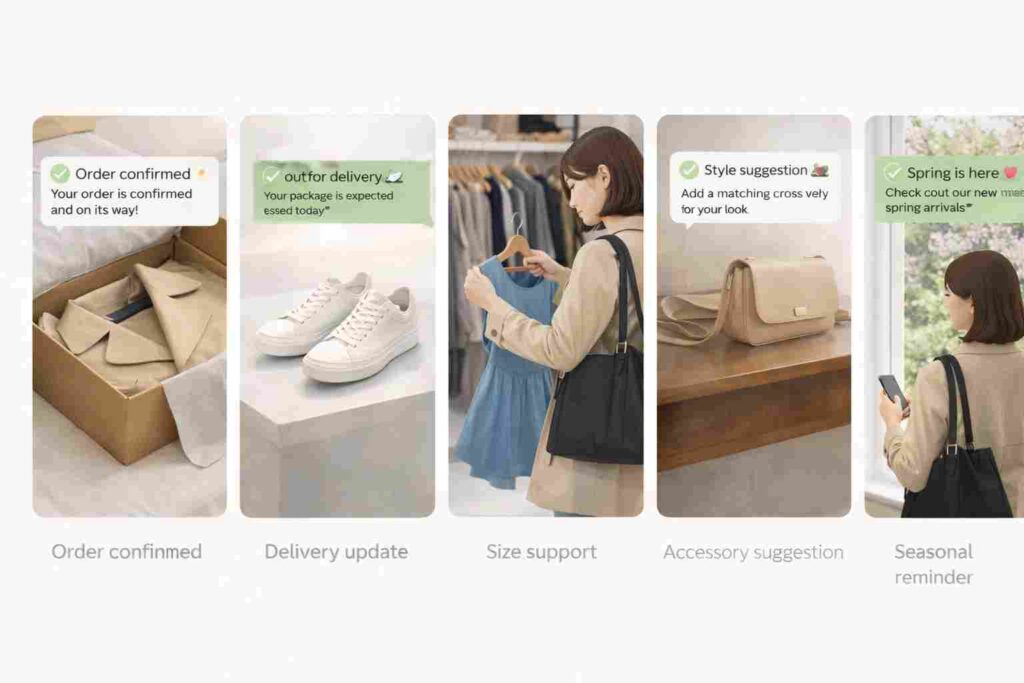
Order confirmation: clarity beats creativity
This is the most expected message and the most important.
An order confirmation WhatsApp message should:
- Clearly restate what was purchased
- Confirm size, quantity, and order ID
- Set delivery or pickup expectations
- Offer a simple support path if something looks wrong
In fashion, ambiguity causes anxiety. Anxiety leads to returns or disengagement. This message is not branding space; it is trust-building infrastructure.
Delivery and fulfilment updates: reduce uncertainty, not add noise
Fashion customers care deeply about when they will receive an order—especially for occasion-led purchases.
Delivery updates should:
- Be event-driven, not scheduled
- Trigger only when status changes
- Avoid unnecessary reminders
A single, well-timed update is more valuable than multiple status pings. Silence between updates is acceptable when expectations are clear.
Size and fit follow-ups: confidence, not correction
This journey is subtle and often mishandled.
A size or fit follow-up should:
- Never assume dissatisfaction
- Never demand feedback
- Feel optional and supportive
For example, a light-touch message that signals support—rather than asking “Was the size okay?” reduces pressure. The intent is to reassure the customer that help is available, not to interrogate their experience.
This journey is especially important for:
- First-time buyers
- Footwear purchases
- Categories with high return risk
Accessory and attachment journeys: relevance over range
Attachment journeys work only when they feel obvious in hindsight.
A customer who bought:
- Shoes may need socks or care products
- Ethnic wear may need matching accessories
- Casual wear may need basics or complements
The rule is simple: suggest one thing, once, at the right time.
These journeys should:
- Activate only after delivery or confidence signals
- Focus on completion, not upselling
- Avoid catalog-style messaging
When attachment feels helpful, it increases AOV without increasing resistance.
Seasonal nudges: reminders, not announcements
Seasonal WhatsApp journeys in fashion should feel like memory prompts, not launches.
Effective seasonal nudges:
- Reference past purchase categories
- Respect typical buying cadence
- Avoid blanket urgency language
A customer who bought winter footwear last year may appreciate a quiet reminder when the season returns. They do not need to be told that “the winter collection is live.”
Seasonality works best when it feels personal, not promotional.
Win-back journeys: one chance, not many
Fashion churn is silent. Win-back journeys must acknowledge that reality.
A good win-back message:
- Is sent once, not repeatedly
- Feels respectful, not desperate
- Does not rely solely on discounts
Sometimes, the best outcome is no response. Automation should accept that and stop. Persistence erodes brand equity faster than silence.
Payment follow-ups (where applicable): utility only
For stores with pay-on-delivery, partial payments, or pending balances, payment follow-ups must be handled carefully.
These messages should:
- Be factual and polite
- Trigger strictly based on payment status
- Avoid emotional or promotional language
In fashion, payment reminders are tolerated only when they are clearly utility-driven and infrequent.
The common thread: messages that feel expected
Across all these journeys, one principle holds:
If the customer expects the message, they read it. If they don’t, they ignore or resent it.
Effective WhatsApp automation in fashion is not about creativity. It is about timing, restraint, and relevance.
Impact & Measurable Outcomes
When WhatsApp automation in fashion shifts from campaign-led to lifecycle-led, the impact shows up quietly but clearly in business metrics. Not as overnight spikes, but as sustained improvements in customer behavior, engagement quality, and operational efficiency.
The outcomes below reflect what fashion, apparel, and footwear brands typically observe when automation is anchored to real purchases and customer context.
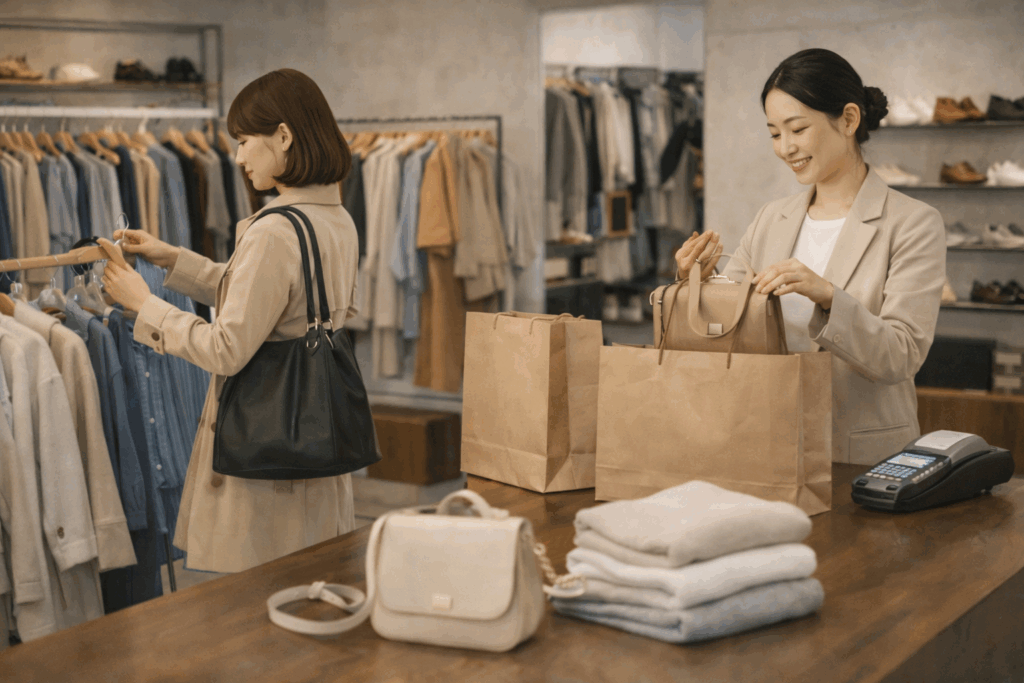
Repeat purchase uplift without constant discounting
The most visible change is an improvement in repeat purchase behavior.
When customers receive:
- Clear post-purchase communication
- Confidence-led follow-ups
- Relevant attachment suggestions
- Seasonally aligned reminders
They return more naturally. Not because they were pushed, but because the brand stayed present at the right moments.
Brands often see:
- A steady lift in second-purchase conversion
- Shorter time between first and second orders
- Higher repeat rates among size-confident customers
Importantly, this happens without increasing discount depth. Relevance replaces price as the primary reactivation lever.
Higher average order value through natural attachment
Attachment journeys driven by actual purchases outperform generic upsell campaigns.
Because suggestions are:
- Category-specific
- Timed post-confidence
- Limited in frequency
Customers are more open to completing their purchase context. The result is a measurable increase in AOV driven by:
- Accessories
- Care products
- Complements and basics
This uplift feels organic to customers, which keeps opt-out rates low.
Reduced manual workload across teams
Lifecycle-led WhatsApp automation removes a significant amount of invisible labour.
Teams no longer need to:
- Prepare customer lists manually
- Tag customers based on assumptions
- Coordinate campaign timing across stores
- Follow up on payments individually
Store staff focus on selling. Central teams focus on strategy. Automation handles consistency.
This reduction in manual effort becomes especially valuable during sales periods and seasonal peaks.
Better engagement metrics that sustain
When messages are expected and relevant:
- Read rates stabilize instead of declining
- Click-through rates remain consistent
- Reply behavior improves for utility and support journeys
- Opt-out rates drop over time
These are not “campaign spikes.” They are signs of channel health.
WhatsApp remains a trusted communication layer instead of degrading into a promotional feed.
Lower opt-outs and stronger long-term trust
One of the most underestimated outcomes is trust preservation.
By respecting:
- Consent
- Timing
- Frequency
- Lifecycle intent
Brands avoid the slow erosion that comes from over-messaging. Customers stay subscribed longer, which compounds value over time.
In fashion, where loyalty is fragile and choice is abundant, staying welcome in the inbox is a competitive advantage.
Outcomes that compound, not spike
The most important thing to understand is this:
Lifecycle-led WhatsApp automation does not create dramatic one-week results. It creates compounding advantage.
Each relevant message reinforces:
- Brand reliability
- Purchase confidence
- Willingness to return
Over time, this shifts the business from chasing demand to supporting it.
End-to-End WhatsApp Automation Flow
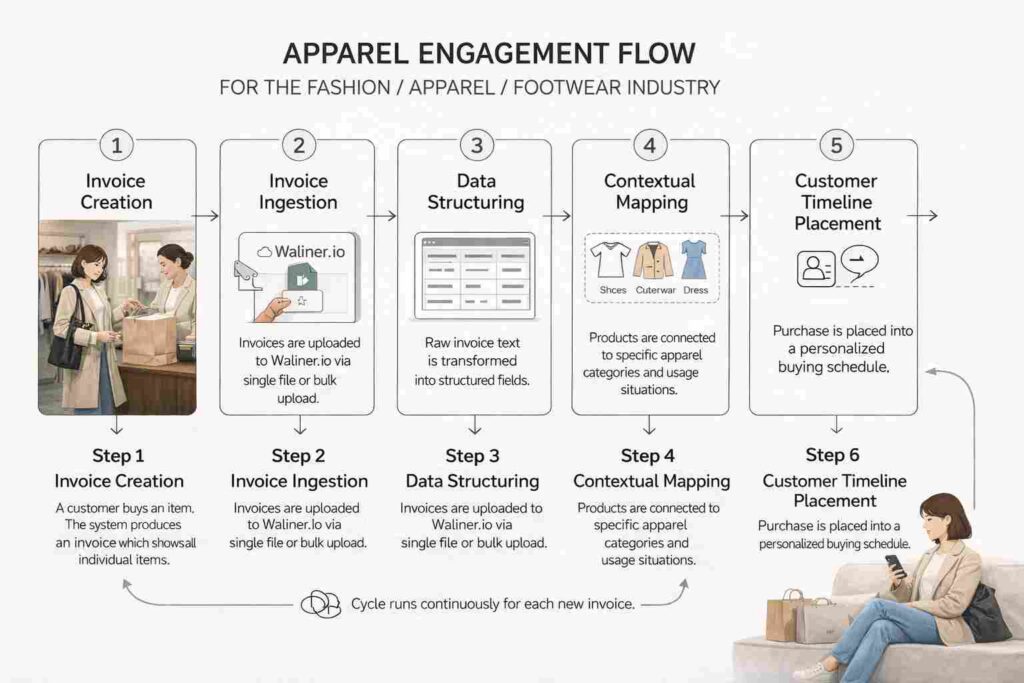
When WhatsApp automation works well in fashion, it feels invisible. There are no obvious “campaigns,” no sudden spikes in messaging, no forced prompts. What exists instead is a quiet, consistent flow that mirrors how customers shop, evaluate, and return.
This is what an end-to-end, lifecycle-led WhatsApp automation flow looks like for fashion, apparel, and footwear brands.
Step 1: A real purchase happens
Everything begins with an actual transaction.
A customer buys a product—in-store or online. An invoice is generated. The brand does not ask the store staff to tag anything, select anything, or remember anything. The sale completes as usual.
This moment matters because it is the only signal that truly reflects intent in fashion.
Step 2: The transaction becomes a trigger
The invoice is not treated as a receipt. It is treated as an event.
From that single document, the system understands:
- What category was purchased
- Whether it was apparel, footwear, or accessories
- What size was chosen
- Whether this is a first or repeat purchase
- The order value and payment status
- The season and timing context
No assumptions. No browsing guesses. Just facts.
Step 3: Eligibility and guardrails are checked
Before any message is even considered, the system asks a set of non-negotiable questions:
- Does the customer have valid WhatsApp consent?
- Are we within quiet hours?
- Has the customer received too many messages recently?
- Is there a higher-priority utility message pending?
- Does this customer’s lifecycle stage justify communication right now?
If the answer to any of these is “no,” nothing is sent.
Silence is treated as a valid outcome.
Step 4: The right journey is selected
If the customer is eligible, the system then determines why it should speak.
Is the intent:
- Utility (order confirmation, delivery update, payment follow-up)?
- Reassurance (post-purchase confidence, size support)?
- Discovery (accessory or complement)?
- Reminder (seasonal relevance, gentle reactivation)?
- Re-entry (win-back for inactivity)?
Only one intent wins at a time. There is no stacking of messages, no parallel nudges, no competing journeys.
Step 5: A WhatsApp message is delivered—once
The message that goes out:
- References the actual purchase
- Matches the customer’s lifecycle stage
- Feels expected in that moment
- Avoids urgency unless it is genuinely required
It is sent once. Not repeated. Not escalated unless the customer’s behavior warrants it.
In fashion, repetition does not increase conversion. It increases resistance.
Step 6: Customer response (or silence) is respected
The system observes what happens next:
- The message is read
- A link is clicked
- A reply is sent
- A purchase is made
- Or nothing happens
All outcomes are treated as signals. Silence is not punished with more messaging. It simply updates the customer’s state.
Step 7: The profile evolves, automation adapts
Each interaction—or lack of it—feeds back into the customer profile:
- Confidence increases or remains unproven
- Attachment appetite becomes clearer
- Churn risk rises or falls
- Timing expectations adjust
Future journeys adapt automatically. Messaging becomes more restrained or more supportive based on demonstrated behavior.
Step 8: Tracking leads to optimization, not noise
Brands see what matters:
- Which journeys drive repeat purchases
- Which categories attach naturally
- Where customers disengage
- How opt-outs correlate with timing and intent
Optimization focuses on decision quality, not message volume.
The transformation
This is the shift that WhatsApp Automation for Fashion Brands enables:
From campaign calendars → to customer lifecycles
From generic broadcasts → to purchase-led relevance
From discount dependence → to confidence-driven repeat buying
From noisy messaging → to trusted communication
When WhatsApp automation is lifecycle-driven, fashion brands stop chasing attention. They earn it quietly, consistently, and at scale.
Recent Posts




Review WhatsApp Automation for Fashion, Apparel & Footwear Brands.