Case Study: Invoice Intelligence for Post-Purchase Engagement in Fashion Retail

The research investigates Waliner.io’s solutions for apparel and retail’s insustries enduring challenge of customers buying once but not returning for additional purchases. The research demonstrates how apparel retailers can develop enduring customer relationships through its analysis of invoice-based data extraction and customer segmentation and lifecycle-driven communication methods. The case study exists for students to analyze in their academic work about retail management and customer analytics and digital transformation courses.
Introduction: The Apparel Retail Paradox
The fashion retail sector exists as a creative industry which builds its operations on design elements and branding strategies and seasonal product trends. The store displays attractive window displays but its business operations continue to face an ongoing functional challenge. Apparel retailers dedicate substantial resources to acquire new customers through discount offers and visual store displays and promotional activities yet they fail to make sufficient investments for maintaining customer loyalty after customers make their purchases.
The relationship between a customer and an apparel store end when they finish their purchase at most retail locations. The system records the transaction while it updates inventory levels and generates either a printed or digital copy of the invoice. The business operation has reached its conclusion because the sale has been finalized. The customer starts their product experience after making this purchase because they will assess the product and determine their next purchasing choice.
The main issue of this research study emerges from the difference between when transactions finish and when business relationships should continue.
Industry Context: How Apparel Buying Behavior Actually Works
The process of customer clothing purchases requires analysis to determine why apparel retail faces challenges with customer retention.
People do not buy clothing items by chance when they make their apparel purchases. They are shaped by:
- Seasonality (summer, winter, festive periods)
- Occasion (daily wear, workwear, celebrations)
- Fit and size preferences
- Comfort over time
- Personal style identity
The customer who purchases a cotton kurta during springtime will consider future purchases of similar items at intervals of months instead of daily. A customer who purchases formal trousers will return them only when their usage pattern requires a new pair. These timelines span many years while following unpredictable patterns which each person experiences in their own unique way.
Most apparel retailers build their customer communication through fixed marketing schedules which do not follow individual customer usage patterns. The company sends identical sale announcements and new collection launches and festive campaigns to all customers regardless of their previous purchase history.
The result creates a situation where customer readiness does not match the messages that the brand communicates to them.
The Central Business Problem: Why Apparel Customers Do Not Return
The low repeat purchase rate in apparel retail exists because customers do not express dissatisfaction with their purchased products. The system produces these results because of three fundamental problems which exist within its structure.
First, retailers do not have an operational system which remembers all the products each customer has purchased. The information which invoices contain becomes useless because it remains unorganized for future use.
Second, engagement tools provide equal treatment to all customers. The system delivers messages through date-based and promotional triggers instead of using relevant content. Customers develop a habit of dismissing these messages throughout their shopping experience.
Third, store staff lack the ability to handle large-scale lifecycle engagement management through manual processes. The implementation of follow-up procedures fails because of excessive patient numbers.
Waliner.io treats this issue as a data utilization problem instead of a marketing challenge.
Waliner’s Conceptual Approach: Reframing the Invoice
The developers of Waliner built its system on a new approach which transforms the traditional invoice structure.
The financial record function of an invoice exists in conventional retail systems. The invoice functions as a behavioural artifact according to Waliner’s system. Customers purchase data shows how the customer made their selection through limitations which included their available time and their financial resources, their fashion preferences and their essential requirements.
Waliner converts static invoice records into customer understanding inputs through its process of data extraction and organization.
This change serves as the base for all other developments. The function of post-purchase communication shifts from trying to persuade customers to delivering content which matters to them.
Methodology: How Waliner Operates in an Apparel Retail Environment
The practical operation of Waliner requires us to establish the definition of methodology which applies to this specific situation. The operational framework of Waliner transforms retail documents into customer intelligence through its methodology which manages store functionality.
The Waliner approach operates differently from standard retail technology deployment because it adapts to existing business operations of apparel retailers without needing system integration or staff behavior modification. The objective involves data interpretation rather than substituting new information for existing data to achieve transformation.
Data Entry Without System Disruption
The apparel retail industry requires operational continuity to function properly. The store staff receives training about billing systems and sales procedures which require infrequent changes because any modifications would lead to operational problems or mistakes. Waliner starts its research by making the first methodological choice to stay away from any actions which could disrupt the normal operation of point-of-sale systems.
Waliner operates with an acceptance system which allows users to input invoices instead of needing direct system connection. The system produces these invoices through digital file generation from the POS system or it scans printed bills to create digital copies. Waliner works with invoices instead of systems to enable adoption without requiring organizations to meet technical standards or obtain vendor approval.
Key characteristics of this approach include:
- No requirement to replace or modify existing POS software.
- No dependency on developer resources.
- Compatibility with both digital and paper-based billing environments.
The design choice enables Waliner to operate at various apparel retailers which span from independent stores to chain-based operations.
Extraction and Interpretation
The system requires Waliner to perform two separate operations which include extraction and interpretation after it enters invoices into the system.
The technical process of Extraction involves identifying and structuring data fields which are found in the invoice. The apparel industry requires businesses to establish product category definitions and size specifications and price points and purchase date records.
The process of interpretation extends past this basic technical requirement. The meaning of apparel products exists beyond what appears on the invoice documentation. The purchase of a festive kurta during October month creates different life cycle effects than buying a daily t-shirt during March. Waliner uses apparel-specific logic to transform extracted data into actual usage patterns which describe how people use their clothing and when they need to buy new items.
Waliner bases its research on the fundamental difference between data extraction and interpretation according to its methodological approach.
Customer Profile Construction
The customer profile in this situation represents how a customer’s fashion choices change throughout purchase duration as a customer. Waliner develops customer profiles based on actual shopping data instead of using statistical population characteristics.
The system builds a customer profile through each invoice submission which reveals their buying preferences and their usual price range and their seasonal shopping habits and their tendency to make repeat purchases. The identified profiles exist as active patterns which continue to evolve. They change as customers’ needs and preferences change.
Waliner bases its profile development on actual invoice data instead of making assumptions which leads to evidence-driven decision making for engagement activities.
Process Explanation: Apparel Engagement Flow
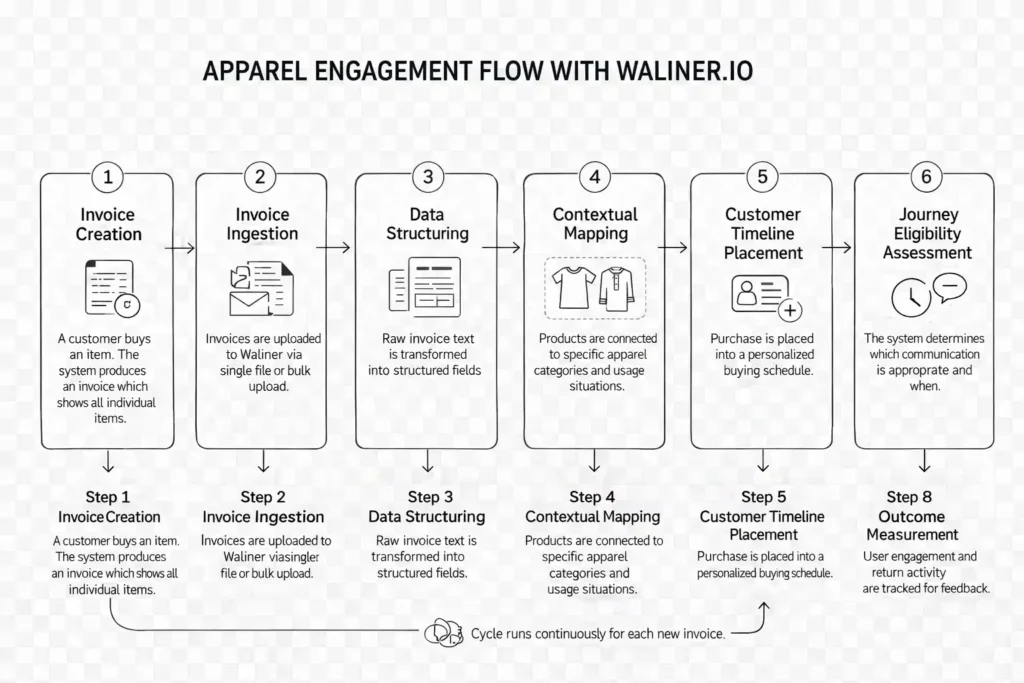
Academic system’s analysis requires the process explanation through narrative methods. It focuses on showing logical steps instead of user interface considerations. The Waliner apparel engagement flow operates as an ongoing process which runs continuously instead of functioning as a single sequential process.
The process starts after a person finishes buying apparel because the system then produces an invoice. The invoice shows completion of the transaction but according to Waliner it marks the start of relationship development.
The system processes the invoice after it becomes part of the system so Waliner can transform unorganized data into organized fields. The research team applied these fields to create apparel-specific categories which represent how people use products instead of using standard product names.
The company positions this purchase at a specific point which matches the customer’s personal time sequence. The timeline shows non-sequential patterns of activity and rest which occur naturally during apparel consumption.
Waliner conducts an assessment to determine if communication should proceed before starting any dialogue. The evaluation process examines three essential factors which include when messages were sent and their connection to specific categories and how many times the audience received previous messages. The system will activate a WhatsApp message only after it confirms the information matches the search criteria.
The system records customer responses or their absence which gets incorporated into the profile to enhance its ability for making better decisions in the future. The process leads to a self-reinforcing system which matches customer actions with their actual behavior patterns.
Process Diagram Explained as Apparel Engagement Flow
Step 1: Invoice Creation
A customer buys an item. The system produces an invoice which shows all individual items in the order.
Step 2: Invoice Ingestion
The invoice gets uploaded to Waliner’s system through either single file upload or mass file upload.
Step 3: Data Structuring
Waliner transforms raw invoice text data into organized fields which can be processed.
Step 4: Contextual Mapping
The system connects every product to specific apparel categories and usage situations.
Step 5: Customer Timeline Placement
The company places this purchase into a personal buying schedule which they have established for this customer.
Step 6: Journey Eligibility Assessment
The system determines which communication method should be used when appropriate.
Step 7: Controlled Communication Execution
The system sends WhatsApp messages which contain only essential information that follows all applicable rules.
Step 8: Outcome Measurement
The system monitors user interaction and their return activities which get incorporated into their individual profiles.
The system runs through this cycle for each incoming invoice which generates a continuous learning process.
7. Apparel-Specific Use Cases and Outcomes
The practical application of Waliner’s methodology becomes clearer through analysis of typical apparel retail scenarios which include specific use cases. The definition of use case in this situation describes specific customer interactions which benefit from proper communication while avoiding any form of intrusion.
Post-Purchase Stabilization
The post-purchase stabilization phase occurs right after customers buy products because they need to assess how well the items fit and how comfortable they are and if they are satisfied with their purchase. Retailers tend to ignore this time frame because it determines how customers will view their business in the future.
Waliner provides retailers with tools to handle this stage by using non-committal messages which offer customers reassurance. The goal is to build customer trust in their existing purchase rather than promoting additional buying. The retailer achieves this goal to decrease uncertainty while building customer trust.
Seasonal Relevance
The way people buy clothing depends heavily on the time of year which makes seasonality a key factor in apparel market trends. The current practice of seasonal engagement uses broad marketing campaigns instead of creating personalized experiences for each customer.
Waliner uses past customer buying patterns to determine which products customers will purchase during different times of the year. The system uses customer purchase history to identify their seasonal buying patterns for specific product categories which determines its engagement strategy. The approach creates seasonal communication that feels current instead of being a repeated message.
Size and Fit Continuity
The process of finding the right fit stands as the most critical element which apparel retailers need to handle. The practice of recommending products without considering customers’ size history results in customer dissatisfaction.
The system maintains size details in each invoice which helps Waliner maintain continuous communication with customers. The system follows known user preferences to minimize their frustration while showing content that seems important to them.
Business Impact for Apparel Retailers
The academic definition of business impact requires analysis of both operational and strategic aspects of the organization.
Waliner operates as an automated system which eliminates the requirement for human intervention to perform segmentation and campaign development. The store team now operates without needing to create contact lists or determine which people to reach out to. The system enables staff members to dedicate their time to delivering better service and product presentation throughout the store.
Waliner creates strategic effects which modify how retailers evaluate customer worth. Retailers now understand their customers better than before because they recognize these customers as people who need different clothing items at various times.
Observed outcomes typically include:
- Increased likelihood of repeat visits
- More stable engagement patterns
- Reduced customer fatigue from irrelevant messaging
- Improved long-term customer relationships
These effects do not appear immediately. The collection of items builds up through time because people buy clothing at a slow pace.
Ethical and Compliance Considerations
Waliner integrates compliance functions into the operational framework of his systems. The system sends messages only when the customer situation requires such communication. The system maintains control over its operating frequency. The system maintains respect for all consent requirements.
The industry depends on this restriction because it operates through trust-based relationships which require individual self-expression.
Conclusion
The apparel retention problem exists because of factors which surpass creative solutions and promotional activities. The failure to understand and respond to available information leads to this condition.
Waliner.io enables users to maintain customer relationships through time by using invoices which function as behavioural records.
Recent Posts





Review Case Study: Invoice Intelligence for Post-Purchase Engagement in Fashion Retail.