How Waliner Turns Pharmacy Invoices into a Refill and Adherence Engine

Technical End to End Explanation of How Invoice Intelligence Solves Refill, Adherence, and OTC Automation Problems
Industry Context
Pharmacies operate with one of the clearest indicators of repeated customer need: medication cycles. Chronic medicines for conditions such as diabetes, hypertension, thyroid dysfunction, anxiety, cholesterol, arthritis, and vitamin deficiencies all follow regular monthly or bi monthly usage patterns. When patients complete one cycle, they almost always require a refill shortly after. Despite this predictable demand, most pharmacies are unable to consistently track whether a patient has reached the expected refill date. The information is present inside invoices, but it is not accessible in structured form.
A typical pharmacy processes thousands of invoices every month. These invoices contain medicine names, strength, quantity, dosage patterns, pack sizes, and category classifications. They also reveal how frequently a patient returns, what categories they buy, and what medicines they take repeatedly. If extracted and analyzed correctly, these invoices provide enough information to model refill patterns, adherence levels, and wellness opportunities.
Yet most pharmacies leave this data untouched. This leads to missed refills, low chronic adherence, minimal cross selling, limited visibility into patient behavior, and a fragmented approach to follow up. Waliner addresses these gaps by converting invoices into structured data and using that data to drive prediction and patient engagement on WhatsApp.
Data and Invoice Landscape in Pharmacy
Pharmacy invoices contain several layers of information needed to understand patient behavior. Each layer contributes to a different part of the analytic and engagement pipeline.
• Customer identity
• Phone number
• Medicine names
• Strength
• Quantity
• Dosage instructions
• Price and payment
• Date and time of purchase
• Tax and billing information
• Notes added by staff
This information allows the system to reconstruct a complete record of the medicines purchased, the probable consumption pattern, and the likely duration of usage. The challenge is that this data lives inside PDFs or printed receipts, often in inconsistent formats.
Invoice structures vary across pharmacies. Some list medicines in a clean table. Others mix item descriptions with dosage and pack details. Some include payment information clearly, while others rely on stamped indicators. Waliner’s extraction engine must handle these variations consistently so that the refill logic remains accurate.
Once extracted, invoice data becomes the backbone of the pharmacy’s predictive models and engagement workflows. At this stage, structured data bridges the gap between raw documents and meaningful insights.
Operational Pain Points for Pharmacies
Pharmacies experience several operational issues when they rely only on manual processes.
• Staff cannot track each patient’s refill dates
• Chronic patients miss doses when reminders are absent
• OTC products are rarely recommended at the right time
• Cross selling is uncoordinated
• Lists for broadcast messages are outdated
• Payment reminders are inconsistent
• There is no structured RFM segmentation
• Customer responsiveness is unknown
These pain points generate an inconsistent customer experience. Patients who rely on pharmacies for recurring needs often fail to receive timely support. Many return late for refills or switch to another store that offers better follow up. The pharmacy can lose long term value without realizing it.
These issues also increase workload. Staff attempt to remember customer patterns but cannot do so reliably. Manual notes and memory based follow ups fail to scale once the number of chronic patients grows beyond a few hundred.
Technical Root Causes of Missed Refills
Several systemic issues prevent pharmacies from effectively managing refill cycles.
First, invoice data is not extracted. Without converting invoices to structured data, pharmacies cannot detect medicine types or predict usage.
Second, there is no mapping between SKU and category. The system must understand whether a medicine is chronic, short term, OTC, wellness, vitamin, or symptomatic.
Third, purchase intervals are not calculated. Chronic adherence depends on tracking how frequently a customer buys a specific item.
Fourth, RFM scoring is not available. Pharmacies need to know who is high value, who is new, and who is at risk of lapse.
Fifth, WhatsApp communication is not tied to customer behavior. Without templates linked to specific triggers, all messaging becomes generic.
Sixth, payment status is not monitored in an automated way. If invoices remain unpaid, staff must manually call or message customers.
These root causes require an integrated system that spans extraction, prediction, segmentation, and engagement. Waliner provides exactly that.
Waliner System Architecture Overview
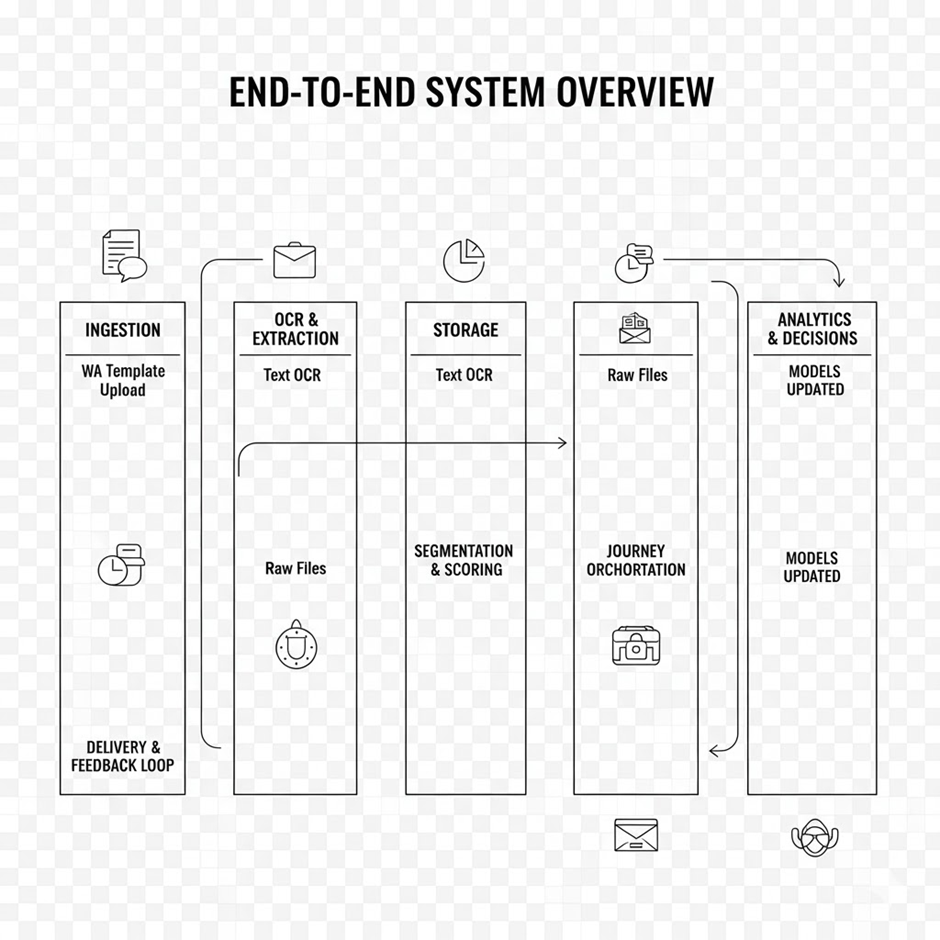
Waliner’s end to end platform uses an invoice centered workflow to manage pharmacy engagement. The core architecture follows a sequence of steps.
• Ingestion
• Pre processing
• OCR extraction
• Entity mapping
• Data normalization
• Customer profiling
• Behavioral scoring
• Replenishment prediction
• Trigger evaluation
• Compliance checks
• Template personalization
• WhatsApp sending
• Event tracking
• Feedback loops
• Analytics dashboards
This architecture aligns directly with the Waliner Invoice Intelligence document and ensures that no part of the workflow depends on manual processes.
Ingestion to Feedback Loop Deep Workflow
The complete operational pipeline looks like this:
Invoice Upload → Pre processing → OCR Extraction → Line Item Mapping → Customer Entity Merge → RFM Scoring → Replenishment Prediction → Trigger Orchestration → Consent and Quiet Hours Logic → Template Delivery → Delivery Read Click Conversion Tracking → Profile Update → Analytics
Each is explained in detail.
Ingestion
Pharmacies upload invoices using a WhatsApp upload template or by dragging PDFs into the portal. No integration with billing software is needed. Staff simply forward the invoices they already produce.
Pre processing
The system converts all files to a consistent format, performs quality checks, removes noise, and prepares them for extraction.
OCR Extraction
The extraction engine reads tables, detects item names, interprets dosage and pack count, identifies price, tax, and total, and extracts payment status when available.
Mapping
Each medicine is matched to a structured category such as chronic medication, short term medication, OTC, supplement, or vitamin. This mapping is essential for understanding patient behavior.
Customer Entity Merge
Phone numbers are normalized to E164 format. Duplicate records are merged so that one customer has a unified profile.
RFM Scoring
Customers receive recency, frequency, and monetary scores that reflect their value and engagement level.
Replenishment Prediction
Waliner calculates the expected end date of each item based on quantity and historical purchase intervals. A customer who buys 30 tablets every month creates a predictable pattern.
Trigger Orchestration
When a patient approaches the predicted refill date, Waliner triggers the appropriate WhatsApp message.
Compliance Checks
Waliner respects consent, frequency limits, and quiet hours. Templates are checked for category compliance.
Template Delivery
Messages are sent through the WhatsApp Business Platform. Each message includes personalized variables pulled from the invoice data.
Tracking
The system captures delivery, read, click, reply, payment, and reorder events.
Feedback Loop
If the patient reorders, all scheduled reminders are cancelled. Profiles are updated based on responsiveness.
Analytics
Pharmacies receive visual dashboards with refill adherence, cohort behavior, SKU trends, and patient segmentation.
This entire loop allows pharmacies to operate with a level of precision that manual methods cannot match.
Replenishment Model Deep Dive
At the heart of the pharmacy use case is the replenishment engine. The model learns from both SKU attributes and historical behavior.
Input Variables
• SKU name
• Pack size
• Strength
• Quantity purchased
• Category classification
• Purchase intervals
• Consumption expectations
• Past adherence
• Customer type
Calculation Method
The model uses historical patterns to align the expected refill date. For example:
Chronic medication
30 tablets → expected 30 day cycle
Vitamin supplements
1 bottle → expected 45 or 60 day cycle
Short term medication
Antibiotics or cough syrups → no refill expected
The system compares the expected consumption rate with the actual return date. Over time, it adjusts the predicted date for each customer.
Behavior Adjustment
If a patient regularly buys early, the model shifts to an earlier expectation. If they consistently buy late, the model recalibrates for a different pattern.
Outcome
The pharmacy gains a clear schedule of when each patient is likely to need a refill.
Segmentation, RFM Logic, and Chronic Identification
Waliner uses a structured segmentation approach.
RFM Segmentation
• High value chronic patients
• Moderate value repeat customers
• Low frequency episodic customers
• At risk customers
• Lapsed customers
Medicine Based Segmentation
• Chronic medication users
• Short term buyers
• Vitamin and wellness shoppers
• Mixed category customers
Behavioral Segmentation
• Customers who respond to messages
• Customers who only click but do not purchase
• Customers who require two reminders
• Customers who ignore reminders
Chronic Identification
Chronic medicines are identified based on name, dosage pattern, and repeated frequency. This ensures accurate prediction and follow up.
Journey Design and Timing Models
Waliner uses several journey templates specifically suited for pharmacies.
Paid Thank You
Sent immediately after purchase. Includes invoice details and expected duration of medicines.
Predictive Refill Reminder
Sent close to the predicted end of the medicine cycle. Provides a direct reorder link.
Non Adherent Reminder
Sent if the patient has not purchased by the late window.
OTC Recommendation
Sent based on SKU adjacency. For example, a diabetes medicine may be paired with a vitamin supplement.
Missed Refill Recovery
Sent to patients who are significantly overdue.
Quarterly Check In
Sent to consistent chronic customers asking about dosage changes.
Unpaid Invoice Reminders
Sent a few hours after delivery and again after a longer interval.
Timing Logic
Pharmacies can adjust timing for chronic and short term items. Most chronic journeys follow a two step reminder cycle.
Detailed Analytics and Decision Layer
Pharmacies gain access to metrics that were previously unavailable.
Adherence Metrics
• On time refill rate
• Days late per refill
• Missed refill percentage
Customer Metrics
• RFM distribution
• Chronic patient segment size
• High value customer retention
Sales Metrics
• Repeat revenue uplift
• OTC cross sell performance
• Category wise reorder trends
Engagement Metrics
• Read rate
• Click rate
• Conversion rate
Decision Layer
The pharmacy can make decisions on:
• Inventory planning
• OTC stocking
• Chronic medication demand
• Timing adjustments
• Offer strategies
Compliance, Consent, and Safety
Waliner ensures all engagement stays within policy.
• All communication uses approved templates
• Utility messages take priority
• Quiet hours prevent late messages
• Consent is required for all proactive messages
• Sensitive medication names can be masked
• Patients can opt out at any time
• Replies open a service window for pharmacist support
These guardrails protect both patient privacy and the pharmacy’s WhatsApp account quality.
Operational Transformation
After implementing Waliner, pharmacies observe several changes.
• Staff no longer need to remember refill dates
• Customers receive timely reminders without manual work
• Chronic patients stay consistent with their cycles
• OTC cross selling becomes targeted
• Payment collection becomes automated
• Analytics provide clear insight into patient behavior
• Operations become predictable rather than reactive
The pharmacy moves from guessing patient needs to understanding them.
Final Summary
Pharmacy operations rely heavily on patient continuity but traditionally lack the tools needed to track or support it. Waliner transforms this landscape by converting invoices into structured data, mapping medicines accurately, predicting refill cycles, segmenting customers, and orchestrating compliant WhatsApp journeys. This system allows pharmacies to improve adherence, increase repeat revenue, automate follow ups, and create a more supportive relationship with their customers.
Recent Posts






Review How Waliner Turns Pharmacy Invoices into a Refill and Adherence Engine.